

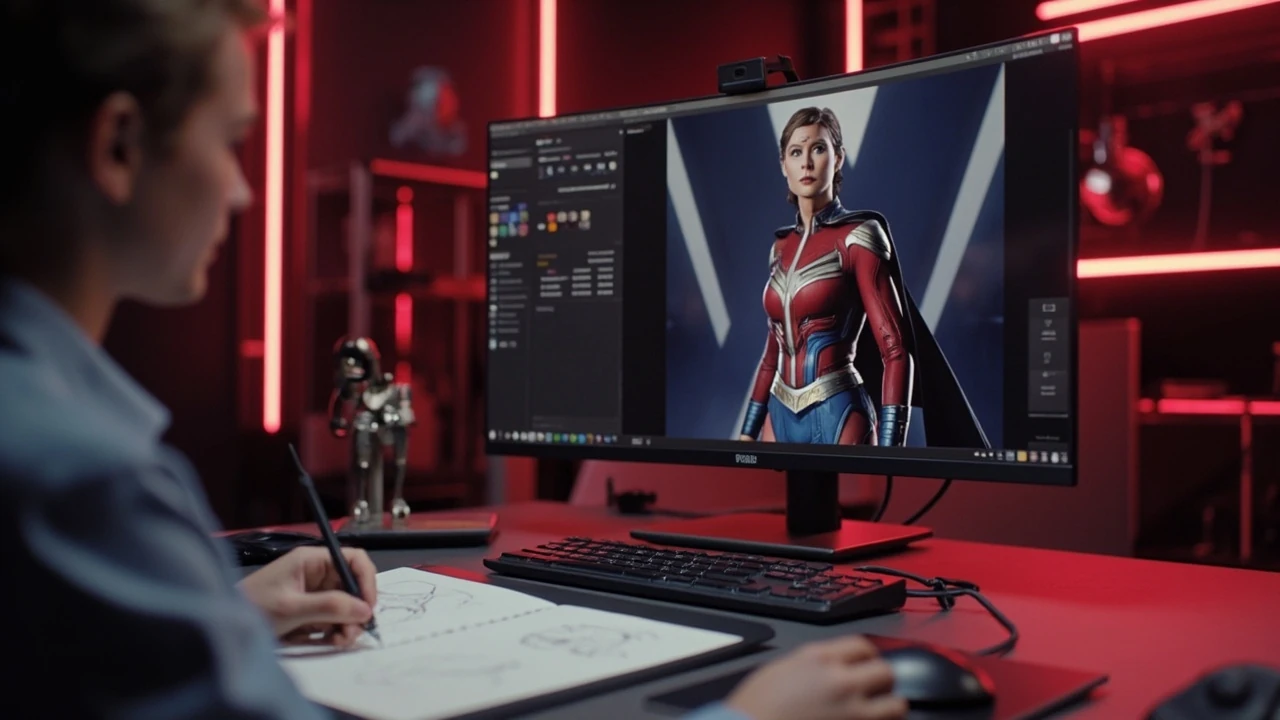
The Boys Firecracker: dissecting a one-note supe for game design
Firecracker, played by Valorie Curry, is the kind of antagonist that game designers argue about for the wrong reasons. She is loud, politically coded, almost absurdly loyal, and she dies on the sharp end of an eagle statue at the tail end of Season 5, Episode 5 of The Boys. Writers call her a flat character. Designers who think in systems call her something more useful: a unit whose entire kit is built around devotion to a single authority figure, and whose design only holds together when that figure is on the stage.
This piece is not a recap of the show, and it is not a defence of the character’s politics. It is a close read of Firecracker as a design object, the way her presence shapes the combat and social loops of the story she lives in, and what indie developers, narrative designers, and combat designers can take from a character who exists almost entirely as a satellite of Homelander. If you are building a game that needs disposable, opinionated villains with strong visual silhouettes and a narrow behavioural range, Firecracker is a useful case study in how to do that on purpose, and how to mark her for the player before she is even on screen.
Who Firecracker is inside the fiction
Inside the show, Firecracker is a former member of Payback, the second-generation superhero team that preceded The Seven in the Vought hierarchy. She later joins The Seven itself as a direct subordinate of Homelander, and her role is straightforward: enforce his will, project his brand, and absorb the consequences when the public turns on him. Her powers are energy-based and explosive, which gives the production team a clean visual vocabulary for her scenes without forcing the writers to define a deeper kit. She is loud, she is recognisable, and she is on screen long enough for the audience to learn the rules she plays by.
Her arc across Seasons 4 and 5 is the part that matters for design. She enters as a true believer, a self-styled patriot who is also a public-facing influencer in the Vought media machine. Over time she trades away every conviction she has, including the parts of her identity that made her interesting in the first place, in order to stay close to Homelander. The story never pretends this is a healthy strategy. It shows her making smaller and smaller choices, each one tightening the leash, until the only move left is to kneel. By the time she reaches Season 5, Episode 5, the show has set up a payoff that the audience can feel coming from a hallway away.
For a game designer, that is a useful template. She is a character who has agency on paper, but whose agency has been funnelled into a single decision tree: stay close to power, or leave. The show makes the cost of staying close visible in every episode, and the cost of leaving visible in her final one. That dual cost is the part most loyalty villains get wrong. They either hide the cost of obedience or skip the cost of exit, and the audience loses interest because the math stops adding up.
Why Firecracker works as a combat and narrative object
Firecracker works because the show does three things consistently, and each one has a direct parallel in game design.
- She has a recognisable silhouette and palette before she speaks a line.
- Her behaviour is narrow enough that the audience can predict her within an episode or two.
- Her narrative purpose is tightly bound to a single authority figure, so her scenes can be staged around contrast rather than exposition.
Take the silhouette. Firecracker’s costume is built around red, white, and blue with a destructive, almost military edge. When she appears in frame, the audience knows what kind of scene it is before the dialogue begins. In a third-person action game, that is the same principle that drives enemy archetypes in Devil May Cry, Bayonetta, and the recent God of War entries. The player learns the silhouette, and the silhouette is a contract about how the fight will feel. If the silhouette changes mid-scene, the contract breaks, and the fight stops feeling earned.
Take the narrow behaviour. She does not improvise. She does not surprise Homelander with new tactics. She reacts, she postures, and she follows. That makes her scenes readable, which is what you want from a support enemy. In game terms, she is a bodyguard archetype, a unit whose threat is positional rather than mechanical. She is dangerous because she is between the player and the objective, not because she forces the player to learn a new timing window. The fight is supposed to feel like a chore, because the chore is the point.
Take the bound purpose. Every scene Firecracker is in is a scene about Homelander, even when he is not on screen. That is a powerful narrative technique, and it has a direct mechanical analogue: enemies that exist to teach the player about the boss they are protecting. The bodyguards in a Souls boss run, the lieutenants in a Far Cry outpost, the named captains in an XCOM mission. They are not the destination, but they teach you what the destination will cost, and they make the destination feel heavier when you finally get there.
Visual and audio design lessons from the character
From a production standpoint, Firecracker is a study in how to design a character who is instantly readable on a noisy screen. Several decisions stand out, and each one is something a small team can imitate without a Hollywood budget.
- Her palette is dominated by a single hot colour. When she shares a frame with Homelander’s blue and crimson, the contrast does the storytelling before the actors say a word.
- Her VFX are loud but contained. Explosions read as personal rather than environmental, which keeps her combat scenes from overwhelming the wider set piece the way a Transformers scrape would.
- Her dialogue delivery is committed. Valorie Curry plays her as someone who has rehearsed her own lines, which gives the character a stagey quality that game writers can imitate when they need an NPC who feels like propaganda in motion.
- Her sound design leans on impact hits and crowd noise. The audience rarely hears Firecracker think. They hear her perform, and the absence of interiority is itself a design choice.
- Her blocking is conservative. She is rarely framed alone in a quiet room, because quiet rooms would force the writing to fill them, and the writing is deliberately thin.
For a game team, the lesson is that a character does not need a deep moveset to feel designed. She needs a clear visual key, a consistent audio key, and a behaviour loop that the player can read in two seconds. If the player cannot tell what an enemy will do when they walk on screen, that is a design bug, not a feature. Fix the bug early, because the rest of the kit will not paper over it.
Firecracker as a bodyguard enemy archetype
If you are designing an action game or a tactics game, Firecracker maps neatly onto what designers often call a bodyguard or lieutenant archetype. The defining traits are simple, and the table below is the kind of cheat sheet that tends to live on a whiteboard next to an encounter designer’s monitor.
| Trait | Firecracker on screen | Game design translation |
|---|---|---|
| Loyalty target | Homelander, singular | Boss entity with an aggro or proximity leash |
| Behaviour range | Aggressive, performative, predictable | Two or three attack patterns, no improvisation |
| Player interaction | Chatter, posturing, intimidation | Voice barks tied to combat state |
| Death cost | Narrative weight, audience relief | Damage to the boss’s phase, or a stagger window |
| Risk if ignored | Area denial, civilian harm | Damage over time, objective loss, civilian kills |
| Animation budget | Reused for several characters, with palette swaps | Shared rig across a faction, recoloured per unit |
| Voice budget | Few lines, repeated with conviction | Four barks per state, cycled with minor variation |
The bodyguard archetype is one of the most reliable ways to make a mid-boss feel meaningful without inflating their mechanical complexity. The trick is to make sure the bodyguard is teaching the player something about the eventual boss. If Firecracker is on screen to teach the player that Homelander is a relationship problem, not just a damage problem, then her scenes are pulling their weight. If she is on screen to delay the boss fight by ninety seconds, she is filler, and the audience will treat her as such even if the cinematics are expensive.
Writing loyalty without flattening the character
The common criticism of Firecracker is that she is one-note. That criticism is fair, and it is also a deliberate design choice that game writers can use if they understand its cost. A one-note character works when the surrounding system is rich enough to make the note feel significant. A one-note character fails when the surrounding system is also thin, because then the audience has nothing to compare her to, and the note starts to feel like a bug.
Here is a practical checklist for writing a loyalty-bound villain without producing a cardboard cutout. These are the rules the show appears to follow, even when the writing is uneven.
- Define the loyalty target before the villain. The audience needs to know who the villain answers to, because that relationship is the point of the character on the page.
- Give the villain a single, visible conviction. Firecracker has patriotism. That conviction is what she trades away, scene by scene, until the trade itself becomes the arc.
- Show the cost of the loyalty in body language, not exposition. The show uses posture, costume, and silence rather than monologues, which is why the death lands without a flashback.
- Make the audience complicit. The viewer is meant to feel the relief of watching her give up the last shred of dignity, and that is a mechanical trick the player can feel when an NPC stops resisting and starts agreeing in real time.
- Plan the death. A loyalty villain needs an exit that the audience can feel coming. If the death feels arbitrary, the character feels arbitrary, and no amount of post-mortem flashback will repair that.
The mistake to avoid is the opposite trap: trying to make a loyalty villain sympathetic by giving them a redemption arc. That dilutes the design. Firecracker does not get a redemption arc. She gets a death that vindicates the audience’s reading of her. Game writers who want to borrow her pattern should respect that ending. A loyalty villain who is forgiven in the final scene is no longer a loyalty villain. They are a redemption case, and that is a different archetype with a different rulebook.
How Firecracker’s death functions mechanically
Her death in Season 5, Episode 5 is worth studying on its own, because it does several mechanical jobs at once. Homelander kills her on a near-whim, impaled on an eagle statue, in a scene that is over in seconds. The death is not a boss fight. It is a system message, the kind of beat that used to live in a season finale and now sits inside a single episode.
| Function | What the death communicates |
|---|---|
| Faction reset | Homelander’s inner circle is no longer safe, and the audience should not assume any of them will survive the season. |
| Character validation | Firecracker’s read of the room was correct. There was no version of this where she walked away. |
| Tonal shift | The show signals that the endgame has begun, and the rules of who matters have changed. |
| Audience release | Long-running tension around a divisive character is discharged in a single image, freeing narrative space for the final arc. |
| Cast economy | A recurring speaking role is freed up, which is a budget decision as much as a story decision. |
| Stakes escalation | The next time a side character stands near Homelander, the audience reads the frame as a threat. |
Game designers run into this problem constantly. A side character has been antagonising the player for hours, and the story needs to land a moment. The temptation is to give that character a boss fight. Often, the better answer is the Firecracker answer: a cutscene, a one-shot kill, a clear and final system message that the player cannot mistake for anything else. The boss fight is for the characters whose death changes the player’s tools. The bodyguard death is for the characters whose death changes the player’s trust in the world. Those are different levers, and mixing them up is one of the more common mistakes in mid-budget action design.
Showrunner Eric Kripke, in conversation with The Hollywood Reporter as reported by IGN, has been explicit about the intent behind the death. The team always knew they would have an episode where Firecracker gives up everything she holds dear, and that Homelander would kill her in that same episode. The pattern he describes, the orbit around a powerful figure who strips away every conviction the follower once had, is the engine that drives the death beat. For designers, that engine is a checklist. If the bodyguard has not given something up on screen, the death is not earned, and the audience will feel the gap even if they cannot name it. As Kripke puts it, “everyone who’s in his orbit gives up every single conviction they’ve ever had, and then he destroys” them, and the showrunner’s framing of the Firecracker death is built around that exact turn, which is worth reading in full at the IGN report on the real-world inspiration behind Firecracker’s fate for any designer who wants to see the writer’s room reasoning laid out.
What indie developers can borrow from her design
If you are working on a smaller project, the parts of Firecracker’s design that scale best are the ones that do not require a big budget. Visual silhouette, audio key, and a tight behaviour loop are all achievable with a small team if the discipline is there. The expensive part of the design is the discipline, not the asset count, and that is good news for studios running on tight schedules.
- Pick one hot colour per archetype. The player should be able to tell a Firecracker-type enemy from a Homelander-type enemy at a glance, even at low resolution on a handheld screen.
- Design the enemy around one relationship. If your enemy answers to a boss, the AI, the dialogue, and the animation set should all reinforce that leash, and the player should be able to see the leash without a tutorial.
- Use voice barks as state machines. Two or three lines per combat state, triggered by health thresholds or proximity, are enough to make a bodyguard feel present without recording a full script.
- Plan the death on paper, not in engine. A loyalty villain’s exit is a writing problem with a small animation cost. Solve the writing first, and the rest of the production will move faster than you expect.
- Resist the urge to explain. Firecracker never gets a monologue about why she joined Homelander. The show shows her kneeling, and that is enough, and a similar restraint will save your writers’ room hours of debate.
- Reuse rigs across a faction. A shared skeleton with palette swaps and prop swaps is the cheapest way to populate a bodyguard roster that still feels distinct.
- Cut the barks you can cut. If a line does not change the player’s behaviour, it is decoration, and decoration is the first thing to lose when the schedule slips.
These are the same rules that drive good enemy design in titles like Returnal, Hades, and Doom Eternal. The fantasy of the enemy is sold in the first second, and the rest of the fight is the player confirming what they already saw. A team that respects that pattern will ship a tighter experience than a team that tries to add depth where the design only needs clarity.
What AAA teams can learn from her limitations
At the other end of the scale, Firecracker is also a useful example of how a high-budget production can still ship a character that does not pay off her own setup. The show spends real money on her VFX, her costume, and her screen time, and the result is a character that a meaningful slice of the audience actively dislikes. That is not a failure of investment. It is a failure of role definition, and it is a failure that big teams are more likely to make because they have the budget to disguise it for several episodes.
When you give a character a big silhouette, a loud moveset, and several episodes of screen time, the audience assumes there is a payoff coming. If the payoff is a death that confirms what they already suspected, you have to make sure the suspicion was the point. With Firecracker, the suspicion was the point, and the design is internally consistent. The risk is that a less disciplined writer can copy the silhouette and the moveset without the discipline, and ship a character that the audience feels they wasted time on, and the wasted time shows up in retention charts within a season.
For a large team, the lesson is to treat the bodyguard archetype as a budget line. If you are spending the money for a full character, the character needs to be doing one of three jobs, and it needs to be doing the job well: teaching the player about the boss, marking a tonal shift, or discharging long-running tension. Firecracker does all three. A cheaper version of the same archetype, written with the same intent, will land just as hard, and the production team will have the budget left over to fix the systems that actually need fixing.
Where the design breaks down
It is worth being honest about where the Firecracker design does not hold up, because the failures are instructive. Several viewers, including critics who cover the show professionally, have noted that her arc leans on real-world political parallels that the writing does not fully develop. The character is positioned as a satire of a particular kind of public figure, and the satire lands hardest for viewers who already share the show’s read. For viewers who do not, the character can feel like a prop rather than a person, and the death can feel like a reward the show is granting its base rather than a beat the story has earned.
In game design terms, that is the same problem you hit when a faction is built around a single real-world reference. If the player does not recognise the reference, the faction reads as arbitrary. If the player does recognise it, the faction can feel like a polemic. The fix is not to abandon satire, because satire is a legitimate tool in a writer’s kit. The fix is to give the satirical character one trait that the satire does not explain, so the player has somewhere to attach their imagination. Firecracker has patriotism, but she does not have a private life. She has a brand, but she does not have a friend. The result is a character who is easy to read and hard to remember, which is the trade-off you accept when you build a villain as a function of someone else’s story rather than as a person in their own right.
Designing a Firecracker-style NPC for a player game
If you want to put a Firecracker-style NPC in a player-facing game, here is a concrete production checklist that has held up across several shipped projects. It assumes a small-to-mid team, a single writer, and a combat or stealth context. The checklist is short on purpose, because the value is in following it, not in admiring it.
- Write a one-page character brief. Name, loyalty target, single visible conviction, one private detail the audience will never see, planned death.
- Block out the silhouette in greybox. If the silhouette does not read at 200 pixels wide, the costume is not done, and the rest of the art pass is wasted.
- Pick one hot colour. Apply it to the silhouette, the VFX, and the HUD icon. Do not introduce a second hot colour for this archetype, because the player needs a single visual key.
- Author two or three attack patterns. Tie each pattern to a body animation the animator can deliver in two weeks, and resist the urge to add a fourth pattern that does not change the player’s options.
- Record voice barks in three buckets: idle, engaged, breaking. Four lines per bucket is enough to ship, and the bucket system will save you during localisation.
- Place the NPC on a leash to the boss. Distance, line of sight, or a scripted call should pull her back to the boss’s side, and the leash should be visible in the AI tree.
- Design the death. Camera, animation, line of dialogue. The death is the contract with the audience, and it needs to be in the design doc from day one, not bolted on in the final sprint.
That checklist will not produce a character as expensive as Firecracker on screen, but it will produce a character that does the same job. The job is to make the player understand the boss by fighting the bodyguard, and to make the boss’s victory feel inevitable by showing the bodyguard go down first. If the player can describe the bodyguard’s job after the encounter, the design has worked, and the encounter will feel like a turning point in the run rather than a delay before one.
Comparing Firecracker to other bodyguard villains
It helps to set Firecracker against other bodyguard-type villains across games and prestige TV, because the differences are where the design lessons live. The table below is a starting point rather than a definitive taxonomy, and the point is to see how the leash changes the character in each case.
| Character | Medium | Loyalty target | Player or audience function |
|---|---|---|---|
| Firecracker | TV, The Boys | Homelander | Teaches that Homelander is a relationship, marks the endgame, discharges tension in a single image. |
| Ornstein and Smough | Game, Dark Souls | Gwyndolin, the kingdom of Anor Londo | Two-phase boss, teaches the player to read a room for a hidden second threat. |
| Lady Maria | Game, Bloodborne: The Old Hunters | The player’s sense of duty, and the memory of a friend | DLC boss, retroactively reframes the base game’s ending. |
| Cersei Lannister | TV, Game of Thrones | Her children, then herself | Long-arc bodyguard, her protection of others becomes her protection of nothing. |
| Magma Wyvern | Game, Monster Hunter | Territory and a wounded elder dragon | Aggressive territorial bodyguard, teaches the hunter to read environmental tells. |
| Jiang Wei | Game, Total War: Three Kingdoms | A succession of liege lords | Officer archetype, leashed to faction rather than a single boss, useful for systemic bodyguard design. |
The pattern across these characters is that the bodyguard role is defined by the leash, not by the moveset. Ornstein and Smough are leashed to a fallen kingdom. Lady Maria is leashed to a memory. Cersei is leashed to her own identity. Firecracker is leashed to a man. When the leash breaks, the bodyguard’s design either ends or transforms, and the audience’s reading of the boss changes with it. That is why bodyguard villains are such a reliable narrative tool. They let the writer change the meaning of the boss without rewriting the boss, which is a budget-friendly move on screen and a design-friendly move in a game engine.
How Firecracker reads in a transmedia context
One of the more interesting things about Firecracker is how she reads across formats. The comics, the show, and the various games tied to the The Boys brand all have to make decisions about how much screen time and how much mechanical depth to give her. The show spends the most on her visually and the least on her mechanically. The games, when they include her, have to either replicate that imbalance or correct for it, and both choices have costs.
For a transmedia design lead, the lesson is that a bodyguard character’s primary asset is recognisability, and recognisability is cheap to ship. A silhouette, a colour, a one-line bark, and a death scene are enough to put the character in a fighting game, a roguelike, or a gacha. Trying to give her a full moveset in a secondary format is usually a mistake, because the audience already knows what she represents. The format should confirm the read, not complicate it, and the moment the secondary format starts explaining the character is the moment the secondary format starts losing the audience.
This is the same logic that drives the design of legacy villains in crossover titles like Marvel vs. Capcom or Super Smash Bros. The point is not to expose a deep kit. The point is to put the silhouette on screen and let the player feel the moment, and the studio that respects that boundary will ship a more coherent roster than the studio that tries to turn every legacy character into a deep system on its own.
Firecracker, Homelander, and the player trust economy
Step back from the character for a second and look at the system. The Boys runs on a trust economy. The audience trusts some characters, mistrusts others, and watches the show rebalance the ledger every episode. Firecracker’s job in that system is to be a known quantity. She is on the side of Homelander, she is not going to switch sides, and her presence in a scene tells the audience what kind of scene it is. That kind of stable signposting is rare, and it is exactly what a long-running game series needs in order to keep its world legible across sequels and expansions.
Games have a similar economy, especially in long-running series. When a Resident Evil player sees a Tyrant, they know what kind of fight is coming. When a Halo player hears a Brute, they know what kind of engagement is coming. When a Dark Souls player sees a golden NPC, they know to watch for the betrayal. Firecracker sits in the same slot. Her presence is a promise about the kind of scene the audience is in, and the show honours that promise every time, which is the part the writers deserve credit for.
Designing a character like that is a skill, and it is one that transfers directly into game design. The trick is to define the promise in the design document, then deliver it in the gameplay. If the promise is “this enemy will not switch sides, but they will die on the boss’s terms,” the player needs to see that promise in the first ten seconds of the fight. Anything else is a contract violation, and contract violations are the kind of thing players remember long after they have stopped thinking about the art style or the frame rate.
Frequently asked questions
What kind of character is Firecracker in The Boys?
Firecracker is a loyalty-bound antagonist whose entire design is built around her relationship to Homelander. She is a bodyguard archetype in narrative terms, a character whose silhouette, dialogue, and death are all functions of the authority figure she serves. She is not a deep protagonist, and the show is consistent about that, which is part of why her arc lands the way it does.
Is Firecracker a supe in the show’s lore?
Yes. She is a supe with energy-based, explosive powers, which gives the production team a clean visual vocabulary for her combat scenes. Her powers are less important to the story than her loyalty, which is the point of her design as a bodyguard character, and the show underlines that by spending more time on her posture than on her VFX.
What does Firecracker’s arc do for the story of The Boys?
Her arc tightens the leash around Homelander’s inner circle and discharges long-running tension before the final act of the show. Her death in Season 5, Episode 5 is a system message that no one in his orbit is safe, and that the endgame has begun, and the showrunners have been open about planning the death as a deliberate turn rather than a late-stage convenience.
Why do game designers talk about Firecracker at all?
Because she is a clean example of a bodyguard villain whose visual key, behaviour range, and death are all designed around a single relationship. That pattern translates directly into enemy and NPC design for action, tactics, and stealth games, and it scales down to small teams without losing the core of the design.
What is the bodyguard archetype in game design?
A bodyguard archetype is an enemy whose threat is positional and relational rather than mechanical. They are dangerous because they are between the player and the boss, and their behaviour is leashed to that boss. The bodyguard’s job is to teach the player about the eventual fight and to mark tonal shifts along the way, and the bodyguard’s death is usually the moment the tonal shift lands.
Can a loyalty villain work in a player-facing game?
Yes, and several shipped titles use the pattern. The key is to define the loyalty target, the single visible conviction, and the planned death before the character is animated. A loyalty villain without a planned exit reads as filler, and filler is the first thing players feel when they start to disengage from a long campaign.
What is the risk of designing a one-note villain?
The risk is that the surrounding system is also thin. A one-note character works when the system around them is rich enough to make the note feel significant. If the boss, the faction, and the world are all underwritten, a one-note villain will feel arbitrary and the audience will disengage, and no amount of extra barks will recover that loss.
How should a small team budget a Firecracker-style NPC?
Treat the silhouette, the colour, and the death as the contract with the player, and budget the rest as iteration. One writer, one animator, one VFX pass, and four voice barks per combat state are enough to ship a bodyguard that lands. The expensive part of the design is the discipline, not the asset count, and a team that respects that order will ship a tighter character than a team that pours budget into extra attacks nobody will use.
Does Firecracker’s political satire help or hurt her as a character?
It depends on the viewer. For viewers who share the show’s read, the satire gives the character a clear function. For viewers who do not, the character can feel like a prop. The fix is to give the satirical character one private trait that the satire does not explain, so the player has somewhere to attach their imagination, and that fix is also a good general rule for any NPC built around a real-world reference.
What is the single biggest design lesson from Firecracker?
Plan the death. A loyalty villain’s exit is the contract with the audience, and it has to be in the design document from day one. If the death feels arbitrary, the character feels arbitrary, and no amount of VFX budget will save the scene, and no amount of post-launch patches will either.


Leave a Reply