
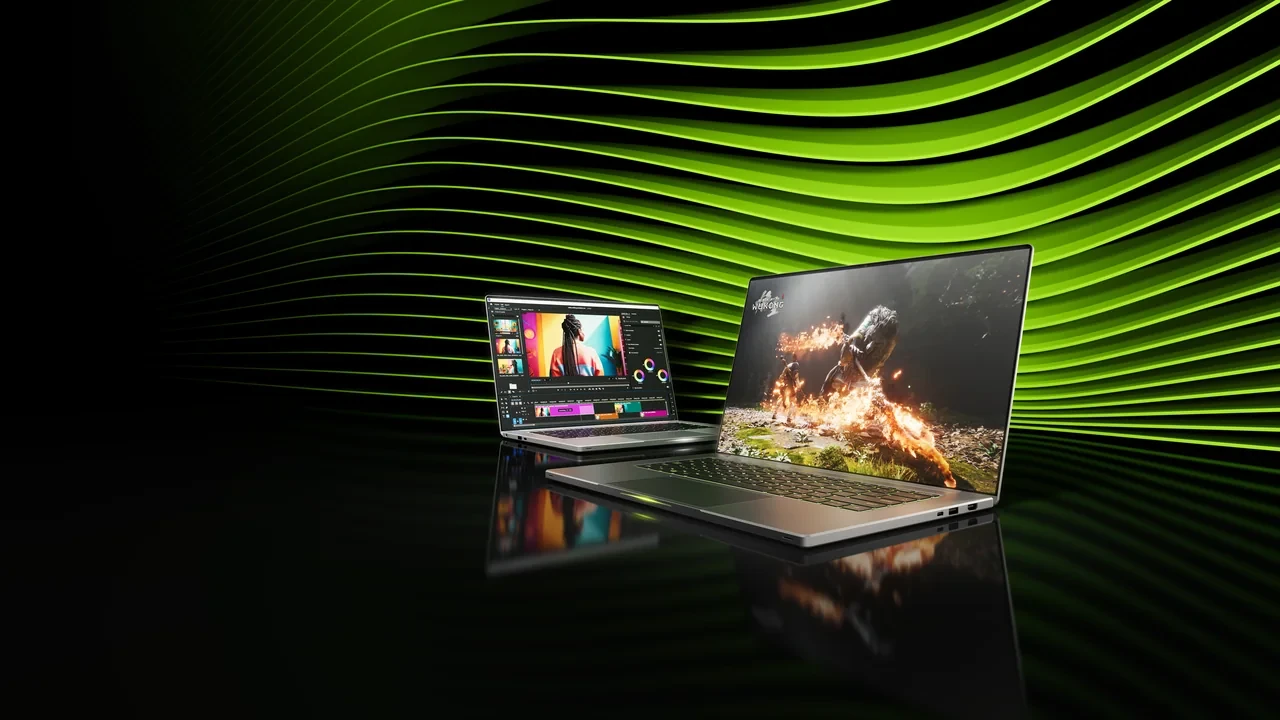
GeForce RTX 5070 Ti Laptop GPU DLSS 5 best settings: a working configuration for laptop builds
DLSS 5 is scheduled for the RTX 50 Series in the September 3, 2026 release window, and the GeForce RTX 5070 Ti Laptop GPU is positioned to use the model-based upscaler in supported games. Desktop presets don’t transfer cleanly to a laptop. Chassis cooling, Dynamic Boost, panel resolution, and the GPU’s available power change the cost of every setting.
Set the power profile and panel target first. Then choose the internal resolution, decide whether frame generation fits the latency budget, and validate the result after the laptop reaches a steady temperature. That order catches the failures most common to notebooks: throttling, VRAM pressure, and a refresh-rate ceiling that makes extra frames pointless.
No exact FPS result is quoted because the supplied source material contains no verified per-title DLSS 5 benchmark for this laptop GPU. The worked example uses a hypothetical 1440p internal render on a 1600p panel and does not present an invented result.
Laptop Power Matters More Than the Name
The desktop and laptop RTX 5070 Ti share a generation and a name, not the same operating envelope. NVIDIA gives OEMs a configurable TGP range, while each manufacturer chooses cooling and power profiles that determine sustained clocks. The available GPU power is therefore a variable, and it decides how much room remains for DLSS 5 at a given internal resolution.
DLSS 5 builds on the architecture family used by DLSS 4. NVIDIA’s research material describes a model-based upscaler and frame-generation path intended to improve temporal stability, reduce ghosting on thin geometry, and reconstruct distant detail more cleanly than older CNN models. The result still depends on the motion vectors, depth data, and per-game training data supplied by the renderer.
Laptop tuning rests on the sustained clock, the fixed panel, and the latency cost of generated frames. A 1600p, 1800p, 4K, or 1080p display sets the visible limit. Frame generation then needs Reflex or a sufficiently high base rate, which is often the first casualty of a restricted power profile.
Start With These Six Decisions
Make these choices in order. Revisiting an early assumption after per-game tuning wastes considerably more time.
- Confirm the laptop’s GPU power profile, the panel’s native resolution, and the panel’s maximum refresh rate.
- Decide the target internal render resolution based on the panel and on whether the title ships with DLSS 5 support at launch.
- Pick a DLSS 5 mode that matches the render budget and the visual priority for the title.
- Set Reflex 2 on for any title that exposes frame generation, so latency is bounded.
- Lock a frame-rate cap at a value that respects both the panel and the input device.
- Validate the configuration with the in-game overlay, an external frame-time capture, and a short session of real gameplay.
Chassis, Power, and Panel Limits
Two laptops carrying this GPU can behave very differently under sustained load. A 16 mm chassis with one fan and a vapor chamber generally holds boost for less time than a 25 mm chassis with dual fans and a dedicated GPU heat pipe, even at the same nominal TGP. TGP is only the configured ceiling; the clock sustained through a 20-minute session is what matters.
OEM utilities usually offer Silent, Balanced, Performance, and Turbo profiles with progressively higher TGP and fan curves. Moving from Silent to Performance can add 10 to 20 percent GPU throughput on a typical RTX 50 Series laptop, at the cost of noise and a warmer keyboard. Tune each intended profile separately rather than assuming Turbo settings will hold in Silent.
A 1080p 144 Hz, 1600p 240 Hz, and 4K 120 Hz panel each require a different internal-to-output ratio. Upscaling cannot reveal detail beyond the display, and frame generation above the refresh ceiling produces frames the panel never shows. Confirm the native mode and refresh range before tuning.
Choosing a DLSS 5 Mode
DLSS 5 retains mode names familiar from DLSS 4 and DLSS 3, but its handling of thin geometry and disocclusion changes the compromise. Choose between quality-leaning, balanced, and performance-leaning modes. The label is a request, not a guaranteed internal resolution; the game selects a value within a range.
Quality-leaning modes keep the internal resolution high and suit detailed textures, ray-traced effects, and slower camera motion. They are a poor fit for a thin chassis in Silent mode if the GPU cannot maintain a useful base rate.
Balanced is the default starting point at native 1600p, trading a little detail for enough base-rate headroom to make frame generation practical. Performance-leaning modes suit 4K panels, Silent mode, heavy ray-traced reflections, and path-traced global illumination.
Match Internal Resolution to the Panel
The internal render resolution is the single largest determinant of GPU cost. On a 1600p laptop panel, a 1280×800 internal render with DLSS 5’s quality-leaning mode and a high-quality reconstruction is usually a better starting point than a 1600×900 internal render with a more aggressive mode. The model has more pixels to work with, and the GPU has less work to do.
On a 4K laptop panel, native rendering is rarely a sensible starting point, even on the 5070 Ti. Begin with the balanced mode at a 2560×1440 internal resolution, then consider a performance-leaning mode for a path-traced title. A 1080p 144 Hz panel is easier to drive: a 960×540 internal render with the quality-leaning mode is often indistinguishable from native at typical viewing distances, leaving more GPU time for ray-traced effects.
Frame Generation Needs a Latency Budget
DLSS 5’s frame generation path inserts synthesized frames between real ones. The benefit is a higher on-screen frame rate; the cost is added latency, because the synthesized frame is shown before the next real frame is ready, and the input that drove the synthesized frame is older than the input that would have driven a real one. On a desktop with a 240 Hz monitor, the cost is manageable. On a laptop with a 165 Hz panel and a 1.5 ms input device, the cost is visible.
Reflex 2 exists to bound that latency. When a title exposes frame generation, Reflex 2 should be on. Reflex 2 reduces render queue depth, aligns the CPU’s input sampling with the GPU’s frame presentation, and reports an end-to-end system latency value through the on-screen overlay. A useful working rule is to ignore frame generation entirely unless Reflex 2 can be enabled in the same title, and to ignore Reflex 2 entirely unless the overlay is visible so the value can be watched.
For competitive or fast-twitch titles, frame generation is usually a net loss on a laptop panel below 240 Hz because the latency cost of a synthesized frame outweighs the smoother output. In a single-player game with cinematic camera movement, it makes more sense once the base rate reaches 60 FPS and generated frames look consistent beside the rendered ones.
Starting Presets by Panel Type
Use these starting configurations for the GeForce RTX 5070 Ti Laptop GPU, then adjust them from the overlay and frame-time capture. They are tuning baselines, not measured FPS claims.
1600p 240 Hz: Balanced by Default
- DLSS 5 mode: balanced, internal render near 1280×800 to 1440×900 depending on the title’s renderer.
- Frame generation: on for slow-camera single-player, off for fast-camera competitive.
- Reflex 2: on whenever frame generation is on.
- Frame cap: equal to the panel’s refresh rate when frame generation is off, two to three times the base rate when frame generation is on.
- Ray tracing: medium preset when present, with the heaviest effect dropped to low.
- Power profile: Performance, with Turbo only if the keyboard deck is acceptable.
4K 120 Hz: Prioritize Image Quality
- DLSS 5 mode: balanced or performance-leaning, internal render at 2560×1440 or 1920×1080 depending on the title.
- Frame generation: on for narrative and open-world, off for any title where input lag is a concern.
- Reflex 2: on whenever frame generation is on.
- Frame cap: 60 FPS when frame generation is off, with a VSync toggle to keep tearing in check.
- Ray tracing: medium to high, with the heaviest effect isolated and reduced first if the base rate falls under 60 FPS.
- Power profile: Turbo if available, with external power connected at all times.
1080p 144 Hz: Prioritize Response
- DLSS 5 mode: quality-leaning, internal render at 960×540 to 1280×720, with the actual internal render chosen by the renderer.
- Frame generation: off.
- Reflex 2: on, with the overlay visible.
- Frame cap: equal to the panel’s refresh rate, with G-Sync or a VSync-on-low-latency mode if available.
- Ray tracing: off, or limited to reflections only on a per-tile basis.
- Power profile: Performance, with the laptop on a hard surface and the vents clear.
Reflex 2, Caps, and Variable Refresh
Reflex 2 cannot fix latency by itself. Its engine hooks reduce queue depth, align input sampling with the start of the GPU frame, and report measured latency through the NVIDIA App overlay. More than 30 ms on a 165 Hz panel indicates that the base rate is too low for useful frame generation. Lower the internal resolution before changing anything else.
Frame caps are the second half of the latency budget. When frame generation is off, the cap should equal the panel’s refresh rate, and G-Sync or a VSync-on-low-latency mode should be on so the GPU does not have to wait for the next vsync. When frame generation is on, the cap should be two to three times the base frame rate, with VSync on so the synthesized frames are presented at a stable cadence. Setting the cap too high wastes GPU time on frames the panel will not display; setting it too low starves frame generation of the base rate it needs to interpolate.
Where the GPU Time Goes
DLSS 5 competes with other renderer passes for a finite GPU budget. Use the workload order below to decide which setting to cut when the base rate falls short.
| Workload | Approximate share of GPU time | First setting to lower | Why lower it first |
|---|---|---|---|
| Base render pass | Largest single block | DLSS 5 internal render resolution | Largest absolute saving per step; the upscaler compensates with a higher-quality reconstruction. |
| Ray-traced reflections | Second largest in RT-heavy titles | Reflection sample count or trace length | Scales superlinearly with pixel count and depth complexity; reducing it preserves a higher base rate than reducing global settings. |
| Path-traced global illumination | Dominant in path-traced titles | Bounce count or noise threshold | Each bounce adds a full pass of ray traversal; one fewer bounce is the largest single saving available. |
| Frame generation | Small but non-zero | Frame generation off, not lower | Frame generation is a binary choice; lowering it produces a worse experience than turning it off and using the saved time for a higher base rate. |
| Post-processing stack | Variable, often underestimated | Heavy bloom and screen-space ambient occlusion | Bloom and SSAO scale with the panel’s resolution, not the internal render, and add cost the upscaler cannot avoid. |
The table is a planning model, not a benchmark. Internal resolution provides the largest saving, ray-traced effects come next, and frame generation should be either enabled or disabled rather than partially compromised.
Proving the Configuration Holds
An overlay screenshot doesn’t prove sustained behavior. A thermally limited laptop can drift considerably during a 20-minute session, so validate the steady state with the following sequence.
- Boot the title, enter the area with the heaviest GPU load, and let the system sit for 10 minutes before reading any number; the first three minutes are not representative of the steady state.
- Capture a 60-second frame-time graph with an external tool or the in-game performance overlay, and confirm that the median frame time matches the reported FPS and that the 1 percent low frame time is within 30 percent of the median.
- Read the GPU power, temperature, and clock from a monitoring overlay; if the clock drops by more than 10 percent from its peak during sustained load, the chassis is thermal-throttling. Lower the internal render resolution next.
- Read the VRAM usage; if the working set is within 10 percent of the GPU’s VRAM, lower texture quality before lowering the internal render resolution, because a VRAM spill will hard-fall the frame rate and is not recoverable inside DLSS 5’s mode choices.
- Read the end-to-end system latency from the Reflex 2 overlay; if it is above 30 ms on a 165 Hz panel, frame generation is paying more than it is buying, and the configuration should be reconsidered without frame generation.
- Repeat the sequence with the laptop on a hard surface, with the vents clear, and with the OEM’s power profile set to the one assumed by the selected configuration.
A profile that passes all six checks should survive a normal session. If it passes only two or three, expect the player or reviewer to see different behavior from the first five minutes of testing.
Diagnosing Laptop-Specific Failures
Identify the symptom before changing the entire preset. Laptop power, thermals, VRAM, and display routing each produce a recognizable failure pattern.
| Symptom | Likely cause | What DLSS 5 setting to change | What to leave alone |
|---|---|---|---|
| Base rate fine for two minutes, then collapses to half | Thermal throttling in the chassis | Lower internal render resolution by one step; switch to a heavier DLSS 5 mode | Power profile, panel refresh, frame cap |
| Frame pacing is even, but the scene stutters on camera cuts | VRAM working set at the edge of capacity | Lower texture quality and shadow atlas size | DLSS 5 mode, internal render resolution |
| On-screen rate is high, but input feels late | Frame generation on, base rate too low | Turn frame generation off, or lower internal render resolution to lift the base rate | Reflex 2 setting |
| Image looks soft in motion, sharp when paused | Performance-leaning mode at a very low internal render | Move one step toward a quality-leaning mode | Frame generation, ray-traced effects |
| Colored smearing on fast-moving fine geometry | Motion vector handling on the renderer side | Wait for a per-title patch that improves motion vectors | DLSS 5 mode, internal render resolution |
| Image looks correct, but the panel’s refresh is capped at 60 Hz | Power profile limited the panel or the GPU’s output | Switch to a higher power profile; check the panel’s mode in the OS | DLSS 5 mode, internal render resolution |
Pay close attention to the final column. A global preset change can hide the cause and make diagnosis harder.
Starting Profiles by Genre
A competitive shooter and a narrative role-playing game need different latency and image-quality trade-offs. Treat each profile as a baseline and run its stated validation before accepting it.
- Competitive shooter: DLSS 5 quality-leaning, frame generation off, Reflex 2 on, frame cap at the panel’s refresh, ray tracing off, on the Performance power profile. Validate that the 1 percent low frame time is within 30 percent of the median, and that the Reflex 2 overlay reports under 25 ms of system latency.
- Open-world action: DLSS 5 balanced, frame generation on, Reflex 2 on, frame cap at two to three times the base rate, ray tracing on medium, on the Performance power profile. Validate that the GPU is not thermal-throttling during a 10-minute cruise, and that the working set stays under the VRAM ceiling.
- Narrative role-playing game: DLSS 5 quality-leaning or balanced depending on the renderer’s cost, frame generation on, Reflex 2 on, frame cap at the panel’s refresh, ray tracing on high if present, on the Performance or Turbo power profile. Validate that the camera cut frames do not stutter, and that the frame-time graph is even across the first 10 minutes.
- Real-time strategy or simulation: DLSS 5 performance-leaning, frame generation off, Reflex 2 off unless the title exposes it, frame cap at the panel’s refresh, ray tracing off, on the Performance power profile. Validate that the scene-scale stutter during a unit-spawn wave is bounded, and that the median frame time holds across a 10-minute match.
- Indie 2D or stylized 3D: DLSS 5 quality-leaning at the highest internal render, frame generation off, Reflex 2 off, frame cap at the panel’s refresh, ray tracing off, on the Balanced power profile. Validate that the input latency is acceptable, because the overhead of the upscaler is wasted if the title is already GPU-light.
Engine Requirements for DLSS 5
For developers and technical artists, DLSS 5 is not one toggle. The SDK exposes upscaling, frame generation, ray-traced denoising, and Reflex 2 as separate modules. Missing motion vectors soften any upscale, while an unavailable queue-depth hook prevents Reflex 2 from doing its job.
- Confirm the renderer is feeding DLSS 5 with screen-space motion vectors that include camera, skeletal, and per-vertex contributions. A common integration bug is skeletal motion that is not propagated, which produces smearing on animated characters.
- Confirm the renderer is exposing the render queue depth to Reflex 2. Without that, the latency overlay is reporting the wrong number, and any decision based on it is invalid.
- Confirm the frame generation path is fed the correct present timing. A renderer that uses a non-standard present path can produce synthesized frames that are out of order, which is visible as a stutter every few seconds.
- Confirm the depth buffer is being shared with the ray-traced effects. A common integration bug is a separate depth buffer for the upscaler and the reflections, which produces a mismatch at silhouettes.
- Confirm the in-game overlay is reading from the same path the player will use. A debug overlay that bypasses the present path is a misleading measurement tool.
These checks cover the integration errors behind the earlier failure symptoms. Complete them before trusting a player-side preset.
Cutting Ray-Traced Cost Without Wrecking the Image
Ray-traced effects are usually the second-largest GPU cost on this laptop part. DLSS 5 reconstructs the base render, but RT effects still use the internal resolution and their own sample counts. A high-quality mode paired with expensive reflections can spend more time tracing reflections than drawing the base frame.
When the base rate is too low, reduce ray-traced effects in this order:
- Drop the reflection sample count and trace length first. Reflections remain legible in motion at lower sample counts, and viewers tend to fill in missing detail.
- Drop the global illumination bounce count next. Each bounce is a full pass of ray traversal, and the perceptual difference between two and three bounces is smaller than the difference between one and two.
- Drop the shadow sample count last. Shadows are sensitive to lower sample counts in open scenes, and a low-sample shadow is more visible than a low-sample reflection.
Path-traced titles are a separate case. When a title is path-traced, the base render is the ray tracer, and DLSS 5’s role shifts to denoising as much as upscaling. The configuration that fits a path-traced title is closer to the path-traced global illumination column of the earlier budget table, and the internal render resolution is the dominant lever.
Manage VRAM Before Upscaling
DLSS 5 doesn’t expand the card’s VRAM. A working set at the limit will stutter as soon as another asset streams in, and the upscaler cannot recover that lost frame time. Set texture quality against measured residency rather than judging it only by appearance.
Reduce VRAM-heavy settings in this order:
- Lower the texture atlas size first. The upscaler can reconstruct texture detail in motion, and a lower atlas size frees a large block of VRAM for a small perceptual cost.
- Lower the shadow atlas size next. Shadow atlases are VRAM-heavy and time-sensitive, and a smaller atlas is a cleaner fix than a lower shadow detail setting.
- Lower the geometry streaming pool last. A smaller pool produces more pop-in, which the upscaler can clean up at the edges but cannot hide in the center of the screen.
The 10-minute warm-up also exposes asset-streaming pressure. A configuration may fit in VRAM at the menu and spill only when the level reaches its heaviest point. Catching that during validation is far cheaper than finding it through player reports.
Worked 1600p Single-Player Profile
Consider a hypothetical single-player flagship on this GPU with a 1600p 240 Hz panel, Performance mode, and external power. It offers path tracing, costly ray-traced reflections, and quality-leaning, balanced, and performance-leaning DLSS 5 modes. The example shows decision order, not measured FPS.
Start with internal resolution. At 1600p native, a quality-leaning mode at 1280×800 and a balanced mode at 1120×700 are both reasonable, but path tracing makes the balanced option the safer opening choice. A 240 Hz panel can benefit from frame generation during slow camera movement, with the Reflex 2 overlay showing the latency cost. Set the reflection sample count and trace length to medium because reflections are the heaviest RT pass, and use two bounces for path-traced global illumination. Cap output at two to three times the base rate with VSync on for an even cadence. Validate on a hard surface with clear vents. If the GPU throttles, lower internal resolution one step; if VRAM is full, lower the texture atlas one step; if Reflex 2 reports more than 30 ms, disable frame generation and measure the base rate again.
The values change by game, but the order holds: internal resolution first, frame generation as an on-or-off decision, RT cost next, then sustained validation.
Fallback for Games Without DLSS 5
Not every title will ship with DLSS 5 support on day one. The launch list depends on per-title SDK integration, which may not be complete before release. If a game does not expose DLSS 5, the GeForce RTX 5070 Ti Laptop GPU can use the previous-generation DLSS path. Apply the same tuning sequence with the older mode names and latency figures.
The same tuning order applies to an older DLSS path. Its quality ceiling is lower, so a path-traced profile that works under DLSS 5 may need a lower internal resolution on the earlier model.
Keep Shared Test Laptops Reproducible
Shared studio laptops need stricter control than personal machines because the chassis, power profile, panel, and driver can all change between sessions. Record the following details before treating one as a measurement system.
- Document the GPU SKU, the panel’s native resolution and refresh, the TGP, and the OEM power profile in a config file alongside the test build. A studio test laptop without a documented profile is one that will produce different numbers the next time it is used.
- Lock the OEM power profile to a single value for the duration of a test campaign. Switching between Performance and Turbo between runs is the most common source of drift in laptop benchmarks.
- Lock the NVIDIA driver version for the duration of a test campaign. A driver change can move a frame rate by a measurable amount, and a benchmark that crosses a driver boundary is not directly comparable to one that does not.
- Run the same validation sequence on every test laptop before using it for a new title. Thermal throttling will understate the platform’s capability and can send tuning in the wrong direction.
- Capture the frame-time graph, the GPU power, the temperature, the VRAM working set, and the Reflex 2 overlay value for every configuration. A configuration that is reported as stable without a frame-time graph is one that has not been measured.
These steps are not unique to DLSS 5. They are the same steps that have applied to laptop benchmarking for several generations, and they remain the smallest set of steps that makes a laptop number comparable to the next one.
Spend the Saved GPU Time Deliberately
DLSS 5 can reconstruct a higher-quality output from a lower internal resolution, freeing GPU time for ray-traced effects or a higher base rate for frame generation. Laptop limits are tighter than desktop limits because thermals, electrical power, and VRAM all compete inside one chassis. Spend the recovered time on the change the player will actually notice, then verify that the machine can sustain it.
The trade between a quality-leaning mode and a balanced mode is the same trade it has been for several generations, and the validation sequence is the same. What changes is the ceiling: a higher ceiling for the quality-leaning mode, a more aggressive option for the performance-leaning mode, and a frame generation path that is a clearer win at slow camera speeds. The ceiling is what the chassis and the panel can deliver, and the configuration has to respect that ceiling before it can use it.
Frequently Asked Questions
Does the GeForce RTX 5070 Ti Laptop GPU support DLSS 5 at launch?
The GeForce RTX 5070 Ti Laptop GPU is part of the RTX 50 Series, and DLSS 5 is scheduled to launch as the next major DLSS release in the September 3, 2026 window. The actual support in a given title depends on whether the title has integrated the DLSS 5 SDK, and the launch list is determined by the developers, not by the GPU. A title that exposes DLSS 5 will work on the 5070 Ti Laptop GPU on day one; a title that does not will fall back to the previous-generation DLSS path on the same GPU.
Should frame generation be on for single-player titles on a 1600p 240 Hz laptop panel?
Yes, for single-player titles with slow camera movement, frame generation can help on a 1600p 240 Hz panel when the base rate is at least 60 FPS and Reflex 2 is enabled. In competitive or fast-camera games on a panel below 240 Hz, the latency cost usually outweighs the smoother output. Check the Reflex 2 overlay: end-to-end system latency above 30 ms on a 165 Hz panel suggests frame generation is costing more than it delivers.
What DLSS 5 mode should be the default on a 4K 120 Hz laptop panel?
Start a 4K 120 Hz laptop panel with the balanced mode at a 2560×1440 internal render. The quality-leaning mode at 2560×1440 suits a non-path-traced title when the chassis is in Turbo, while the performance-leaning mode at 1920×1080 better fits path tracing or Silent mode. Internal resolution is the largest lever, and the mode name is a request rather than a guarantee.
How is DLSS 5 different from DLSS 4 on a laptop?
DLSS 5 builds on the same architecture family as DLSS 4, and the new model improves temporal stability, reduces ghosting on thin geometry, and provides a higher-quality long-range reconstruction of detail. The exact way the new model reconstructs detail still depends on the renderer’s exposure of motion vectors, depth, and the per-game training data the title ships with. On a laptop, the practical difference is a wider sweet spot for the upscaling modes, a clearer win for frame generation at slow camera speeds, and a slightly different interaction with ray-traced effects.
Which power profile should be used for DLSS 5 tuning?
Use Performance for the main tuning pass because it best represents normal gaming use. Add a Turbo pass when the chassis can hold boost without making the keyboard deck unacceptable. Silent is a poor baseline because its power limits won’t represent normal play. Document the OEM profile and keep it locked throughout the measurement campaign.
Why does a configuration that is stable in the first five minutes become unstable after ten minutes?
The most common cause is thermal throttling. The chassis can hold its boost clock for a few minutes, then lose frequency as the heat sink saturates. That lowers the base rate, cuts frame-generation headroom, and may push latency past the chosen threshold. The 10-minute warm-up is there to catch exactly this behavior. Lower the internal render resolution rather than selecting a more aggressive DLSS 5 mode.
What should be cut first when the VRAM working set is near the ceiling?
Lower the texture atlas size first, then the shadow atlas size, then the geometry streaming pool. Cutting in this order preserves the settings that the upscaler cannot compensate for and reduces the ones that it can. The VRAM working set should be monitored with a separate tool, not the in-game overlay, because the in-game overlay reports the renderer’s working set and not the driver’s, and the two can differ by a meaningful amount on a laptop.
Can the GeForce RTX 5070 Ti Laptop GPU replace a desktop RTX 5070 Ti for development work?
The laptop GPU is useful for development but should measure only laptop-class performance. A studio machine with documented hardware, a locked power profile, and a locked driver can validate the configuration. Use a desktop for desktop-class results and keep the datasets separate. No per-title DLSS 5 benchmark is quoted because the supplied sources contain no verified figure for this laptop GPU.
How does Reflex 2 interact with frame generation on a laptop?
Reflex 2 reduces render queue depth, aligns the CPU’s input sampling with the GPU’s frame presentation, and reports an end-to-end system latency value through the on-screen overlay. Frame generation inserts synthesized frames between real ones, and Reflex 2 is what bounds the latency cost of those synthesized frames. Frame generation without Reflex 2 on a laptop is a net loss in most titles, because the latency cost of the synthesized frame is paid without the alignment that Reflex 2 provides. Reflex 2 should be on for any title that exposes frame generation, and the overlay should be visible so the value can be watched.
Which DLSS 5 setting matters most on a laptop?
Internal render resolution matters most because it has the largest effect on base frame rate, while the upscaler rebuilds the lower-resolution input. The mode name requests a range rather than guaranteeing an exact value. Get that input resolution wrong and the other sliders cannot fully repair the result.




Leave a Reply