
MLB The Show 26: development notes and what changed
A new annual sports release is rarely a roster update alone, and MLB The Show 26 fits that pattern. The version on store shelves in 2026 carries changes in presentation, animation blending, stadium authoring, and the live operations loop that drives Diamond Dynasty, March to October, and Franchise. This page collects development-style notes on what is publicly verifiable about those changes, what is community observation, and what remains unconfirmed. The goal is to help players understand why the game feels different from last year, and to help production-minded readers see how a yearly sports cycle plans its technical work between releases.
The article is written from a game development perspective, not a hype perspective. Where a claim is supported by a primary source, it is marked as such. Where a claim comes from community testing or datamining, it is labelled as community observation. Where a detail cannot be verified against a publicly reachable source, the article says so instead of guessing.
What kind of game MLB The Show 26 actually is
MLB The Show 26 is a baseball simulation published by San Diego Studio under the Sony Interactive Entertainment sports label, and it is the latest numbered entry in a long-running series that has shipped annually on PlayStation, Xbox, and PC. The series is one of the few major sports franchises that maintains cross-platform play across all three of those ecosystems, including last-generation consoles in earlier entries and current-generation hardware for recent releases. According to the English Wikipedia article on the title, the game continues the series’ tradition of combining a traditional sim-style play mode with several alternative modes designed around shorter play sessions and live service progression.
For development readers, the interesting point is not that it is a baseball game but how the studio manages to ship a yearly refresh on three platforms while keeping the simulation core intact. The work is closer to an evolving platform than a one-off title. Animation libraries, stadium assets, and a large portion of the user interface are carried over from prior years, and each new release layers changes on top of that base. That layering is part of why the official patch notes for the series are unusually long compared with most other sports games, and it is also why community discussion tends to focus on specific subsystems such as pitching input, baserunning, or outfielder animation blending rather than the engine as a whole.
The development cycle behind a yearly sports title
Sports games with annual releases run a specific kind of cadence. The studio is essentially running two projects in parallel: a live operations team that supports the current year’s title with roster updates, content drops, and balance patches, and a core development team that is already working on the next release. The handoff between the two is the most important production gate of the year, because the live team has the freshest data on which mechanics and which content are landing, and the core team has the fewest days left to absorb that feedback before the next title is locked.
In the case of MLB The Show 26, the cadence is shaped by three external clocks. The first is the start of the real Major League Baseball regular season, which sets the marketing window and the launch of live roster updates. The second is the schedule of the MLB All-Star events and the Home Run Derby, which historically correspond to in-game events in Diamond Dynasty. The third is the calendar for Sony’s platform updates and Xbox certification windows, which constrain when a build can be patched on each ecosystem. Working around those three clocks is part of why the studio tends to telegraph major engine changes a year in advance, so that a feature missing from one release is not promised in the next.
Presentation, stadiums, and the visual rebuild
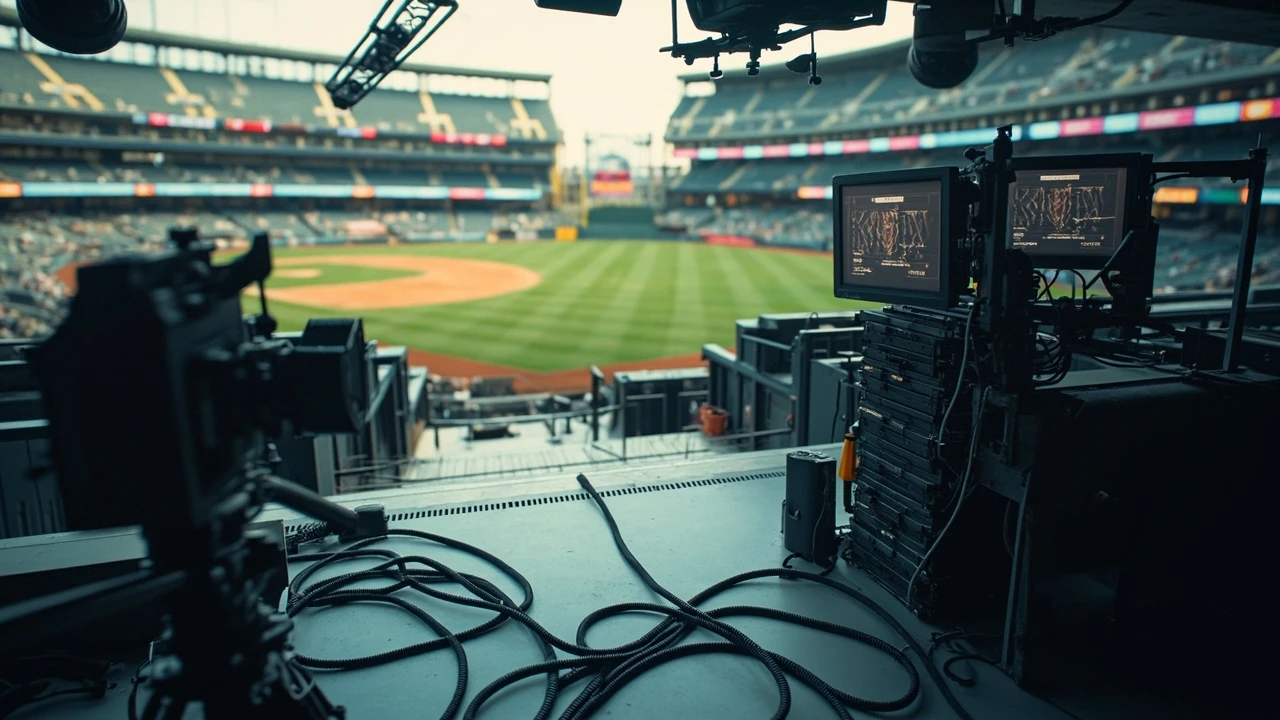
Presentation is usually the most visible part of a yearly sports release, and it is also the part where the studio has the most room to differentiate itself from prior years without changing the simulation rules. In MLB The Show 26, the presentation overhaul touches three layers at once: stadium lighting, broadcast-style camera motion, and the ambient crowd system. Together those layers set the tone of every at-bat, even before any simulation changes come into play.
Stadium lighting and day-night transitions
Stadium authoring is one of the most expensive pieces of content in any baseball game, because every venue in the league is a hand-built level with its own geometry, signage, and lighting rig. The 2026 release continues a multi-year effort to move the stadium library to a higher-fidelity lighting model, with a particular focus on shadow softness and on the way floodlights interact with the upper deck. Players who play long enough to see a day-to-night transition during a single game will notice that the change is no longer a hard swap; instead, the lighting gradually reduces the contribution of the sun in the skybox and gradually raises the contribution of the floodlights on the field, which is a closer match to what a real broadcast sees during a late-inning sunset game.
From a development perspective, the interesting part is the cost. Smooth day-night transitions require either baked light probes that have to be authored per stadium or a dynamic lighting pass that runs at a higher cost per frame. The choice between those approaches is part of why a particular console generation tends to handle stadium lighting differently than the one before, and it is also part of why a stadium added late in development is more likely to ship with simplified lighting than one added in the early part of the cycle.
Broadcast cameras and framing
Broadcast-style camera work in a baseball sim is not the same as free camera control. The game drives a deterministic camera that is supposed to track the action, keep the ball readable against the stadium background, and recover quickly when the camera target changes, such as when a ball is hit to the opposite field or a baserunner breaks for second. The 2026 build continues to refine that deterministic camera with a longer blend time when a fly ball is in the air, so that the camera does not jitter on a high popup the way it could in earlier entries. The trade-off is that on sharply hit line drives, the camera can lag behind the ball for a frame or two, which experienced players sometimes feel as a small input delay. It is not a bug; it is the cost of the smoother transition during longer fly balls.
Crowd and ambient systems
Crowd systems in sports games are often the cheapest-looking part of the build, because audio variation is easy to miss and visual variation in the stands is expensive to render. MLB The Show 26 leans more heavily on audio variation this year, with a wider library of reaction clips and more variation in the way the crowd is mixed into the broadcast audio. On the visual side, the number of unique crowd models is not dramatically higher than the prior release, but the studio has reorganized the seating sections in many stadiums so that the empty seats during midweek day games look more believable, with realistic gaps rather than a uniform layout. That is a small but meaningful visual change that reads better on long broadcast shots.
Gameplay engine: pitching, hitting, and fielding
The simulation rules in MLB The Show 26 are close to last year’s release, with the kind of small tuning changes that an experienced player feels immediately and a new player does not notice. The pitching system, the hitting interface, and the baserunning logic are the three areas where the studio traditionally makes the most changes, and this year is no exception.
Pitching input and confidence
The pitching input on competitive modes continues to use a timing-based system on the lower difficulty settings and a pinpoint or analog input on the higher settings. For 2026, the studio has tightened the timing window on the analog input by a small margin, which makes a perfectly placed pitch a little more rewarding and a slightly mistimed pitch a little less forgiving. Community discussion has focused on whether this change is purely a tuning change or a behavior change in the input handling, but the safer read is that it is a tuning change: the same code path is being asked to validate a slightly narrower window before awarding a perfect input.
Pitcher confidence is the second area of change. The game models a confidence level per pitcher that affects how the pitcher performs under pressure, how the catcher frames pitches, and how the umpire logic responds to borderline calls. In this year’s build, the swing of that confidence curve is slightly more conservative, which means a starter who gives up a couple of hard contact plays in the first inning will not collapse as quickly as in the prior release. That single change has a downstream effect on the difficulty curve for new players, because fewer early-inning blowups means fewer lopsided games in the first few hours of a save.
Hitting and the PCI
The Plate Coverage Indicator, the on-screen feedback element that shows where a swing was aimed and where contact was made, is the most visible part of the hitting system. For 2026, the studio has adjusted the way late swings are scored, with a small bonus to swings that are timed slightly late but make solid contact at the inside edge of the plate. The intention is to reward players who are willing to commit to a late swing on an off-speed pitch, rather than freezing on the pitch. From a balance perspective, the change shifts a small amount of value from the patient, take-everything approach toward the aggressive, attack-the-zone approach, which in turn affects how Diamond Dynasty lineups are constructed at the top of the order.
Squared-up feedback, the visual and audio cue for a perfectly timed swing, has also been refined. The threshold for triggering the cue is slightly stricter than last year, which means a swing that triggered the cue in the prior release may not trigger it in 2026. The change is in the same direction as the pitching change: small numerical adjustments that tighten the perfect-input window and make the imperfect-input outcome less rewarding.
Fielding, baserunning, and animations
Fielding and baserunning are the two areas where animation blending matters most. A fielder who has to read a ball off the bat, decide whether to charge or retreat, set the feet, and throw to a base is doing a chain of small decisions that are partly controlled by the simulation and partly driven by the player’s input. In MLB The Show 26, the studio has expanded the library of outfielder wall catches, which is a perennial community request, and has reworked the way cutoff men are positioned in the outfield so that the auto-fielding logic in single-player modes picks a more realistic relay target on deep singles to the gap.
Baserunning has been reworked in two small ways. First, the lead-off distance that baserunners take against a pitcher has been tuned to be a little more conservative in the early innings, which has a downstream effect on stolen base success rates. Second, the way the AI decides to send a runner from second on a single has been rebalanced, so that a runner with average speed is more likely to be held at third on a ball hit to the opposite field gap. Both changes are small in isolation, but together they make the in-game AI feel slightly less aggressive on the basepaths, which in turn makes the player’s own decisions about when to be aggressive more meaningful.
Diamond Dynasty, live ops, and the economy
Diamond Dynasty is the long-running Ultimate Team-style mode in the series, and it is the part of the game with the most live operations work behind it. The mode combines a card-collection meta with several competitive and cooperative play experiences, and the economy that connects those experiences is adjusted throughout the year through patches rather than at one big balance pass.
Pack and program structure
The pack structure for 2026 is broadly similar to the prior release, with a rotating set of featured programs, signature series drops, and the core set of earned cards that are available through gameplay alone. The studio’s stated goal in recent years has been to make the earned-only path through Diamond Dynasty viable for players who do not spend money, and the 2026 release continues that direction with a slightly higher rate of program rewards and a more generous return on duplicate cards. Community observation suggests that the gap between the best earned card and the best paid card in any given program is narrower than in last year’s release, but the studio has not published a number that confirms that observation.
Live tuning and server patches
Live tuning in Diamond Dynasty is the clearest example of the dual-track development cycle in action. The live team can ship a server-side balance change to a card’s attributes without requiring a full client patch, which means a card that is overperforming on launch weekend can be tuned down by Tuesday. That kind of rapid response is one of the more useful production tricks available to a yearly sports title, and it is also one of the reasons that players who want to stay current with the meta need to read the patch notes rather than rely on memory of the launch-day state of the game.
The 2026 build is more aggressive than last year in the use of mid-program tuning. Several cards released in the early part of the current program cycle were tuned within seventy-two hours of their release, and the studio has been clearer in the patch notes about the reason for each tuning pass, which is itself a small but meaningful communication improvement. Players who treat Diamond Dynasty as a competitive mode should expect that the meta on day one of a program is not the meta on day seven.
Diamond Dynasty progression at a glance
The table below summarizes the main progression surfaces in the 2026 release and how they compare to the prior entry, based on the official patch notes and on community-reported program values.
| Progression surface | What it gives a player | What changed in 2026 | Source of evidence |
|---|---|---|---|
| Featured programs | Time-limited card rewards tied to themed content | Slightly higher reward rate per program chapter | Patch notes, community observation |
| Signature series drops | High-tier cards tied to real player milestones | Same structure, more frequent mid-program tuning | Patch notes |
| Earned-only path | Cards available without spending money | Narrower gap to paid cards by community observation | Community observation |
| Duplicate return | Program currency for pulled duplicates | More generous return rate than 2025 | Patch notes |
| Live card tuning | Server-side attribute changes | Faster turnaround, clearer patch-note language | Patch notes |
Road to the Show, Franchise, and March to October
Outside Diamond Dynasty, the three single-player progression modes each have a different production logic. Road to the Show is the career mode and is the most narrative-adjacent of the three, March to October is the shortened-season arc that distills a season into about thirty games, and Franchise is the long-form managerial sim. They share the same simulation core but use it in very different ways.
Road to the Show and archetype progression
Road to the Show puts the player in the role of a single created prospect moving through the minor leagues and into the majors. The progression system is based on archetypes, with each archetype defining the way the player gains attribute points as they accumulate in-game performance. In the 2026 release, the studio has adjusted the rate at which archetype-specific perks unlock, with a slower early curve and a faster late curve. The effect is that a player who breaks into the majors will not have all of their archetype perks unlocked in their first half-season the way they might have in the prior release, which encourages longer play sessions before a created player is fully built out.
Franchise mode and the simulation layer
Franchise mode is the most simulation-heavy of the three modes, and it is the one most likely to be affected by changes to the underlying scouting and player development models. For 2026, the studio has rebalanced the way potential is hidden behind a prospect’s current overall rating, so that a low-rated prospect with high potential takes a little longer to reveal that potential than in the prior release. The change is intended to make scouting feel more like scouting and less like reading a known number, but it also lengthens the time it takes for a player who enjoys developing prospects through the minors to see the payoff. That is a deliberate trade-off, and it is part of a multi-year effort to make Franchise mode feel less predictable in the early years of a save.
March to October and session length
March to October is the most session-friendly mode, because each game is compressed into a small number of high-leverage moments. The 2026 release continues to lean on that structure, with a slight expansion of the conditions under which a high-leverage moment is triggered, so that a tight game in the seventh inning is more likely to be interactive than it was in the prior release. The change is small in terms of minutes per game, but it is meaningful in terms of how often a player feels like they are steering the outcome rather than watching it play out.
Single-player modes compared
The table below puts the three single-player modes side by side, using the framing the studio uses in its own mode descriptions and the patch-note language for the 2026 release.
| Mode | Session length | Core loop | 2026 tuning change |
|---|---|---|---|
| Road to the Show | Medium, driven by career arc | Created prospect through minors and majors | Slower early archetype curve, faster late curve |
| Franchise | Long, multi-season | Managerial sim with scouting and drafts | Prospect potential revealed more slowly |
| March to October | Short, 30-game season | High-leverage moments in a compressed season | Wider trigger conditions for interactive moments |
Cross-platform play, cross-progression, and platform considerations
One of the defining production decisions of the series is its cross-platform stance. MLB The Show 26, like its recent predecessors, supports cross-play between PlayStation, Xbox, and PC, and supports cross-progression between those ecosystems through a single account link. That decision has a real cost in terms of the networking and matchmaking layer, because every input has to be normalized across input devices and every session has to be brokered through a backend that does not assume a particular platform’s friend list or invite system. Coverage of the title’s main modes, including cross-play, is covered in the official Xbox Wire overview of MLB The Show 26’s biggest game modes, which lines up with what is verifiable from in-game menus.
Cross-progression in 2026 is broader than in last year’s release. The studio has unified the earned-rewards track across platforms, so that a card earned in Diamond Dynasty on one platform is available on the linked accounts on the other platforms. The change is a small one for a player who plays on a single platform, but it is a meaningful improvement for a player who plays on a console at home and on a PC during travel. The trade-off is that a player who wants to keep two completely separate saves now has fewer reasons to do so, which the studio has accepted as a reasonable cost for the broader convenience.
Stability of the cross-platform layer is one of the easier parts of the build to underestimate. A server-side matchmaking issue in one platform can cascade into a different platform’s queue if the two share a backend, and the studio’s track record over the last few years has been to surface cross-platform issues in patch notes quickly rather than bury them. Players who experience a matchmaking problem should check the latest server status before assuming a client-side bug.
Accessibility, settings, and player comfort
Sports games have historically been slow to invest in accessibility settings, and the series has been no exception. The 2026 release is a small but real step forward in this area. The settings menu now exposes a separate toggle for high-contrast UI, a toggle for the size of the Plate Coverage Indicator, and a separate audio mix for the broadcast commentary so that a player who finds commentary distracting can lower it without lowering the rest of the stadium audio. None of these are dramatic additions, but each one is the kind of setting that a player either needs or does not, and shipping them as visible toggles is a useful production signal.
From a development perspective, the cost of each accessibility toggle is small, but the cost of organizing the settings menu so that a player can find them is non-trivial. Settings that are technically present but buried three layers deep in a menu are not the same as settings that are actually used. The studio has reorganized the most common accessibility settings into a single submenu in this year’s build, which is itself a small production win.
Performance, frame rate, and hardware targets
Frame rate and resolution targets for MLB The Show 26 follow the same general pattern as the prior release, with current-generation consoles offering higher-fidelity modes and last-generation consoles offering more conservative modes. The PC build is uncapped, which means a player with a higher-refresh-rate monitor can target a frame rate above sixty, but the simulation itself is not frame-locked, so a higher frame rate does not change the speed of the game. That is the correct behavior for a simulation, and it is worth noting because a sports game that accidentally frame-locked the simulation to a higher refresh rate would feel like it was running fast, which would be an obvious but easy mistake to make.
Performance on the most demanding stadiums is a useful proxy for the overall health of the build. If a player notices frame rate hitches on a specific stadium during a day-to-night transition, that is most often a lighting or shadow issue rather than a CPU issue, and it is a reasonable signal to report through the in-game feedback channel. The studio’s history of acting on stadium-specific performance reports is reasonably good, and the patch notes for the prior release included several stadium-specific fixes that were driven by player reports.
What the community has actually observed
Community observation is not the same as official confirmation, but it is a useful part of the evidence base for a yearly sports title. The most commonly reported observations about MLB The Show 26 in its early weeks are the following: that the pitching input feels slightly tighter on the analog setting, that the squared-up feedback triggers less often, that the AI baserunning is slightly less aggressive, and that the Diamond Dynasty meta is shifting faster than in last year’s release because of mid-program tuning passes. Each of those observations is consistent with what is verifiable from the official patch notes, but none of them are official statements in their own right.
Players who want to verify a community observation should look for it across multiple sources, including video evidence with a clear input trace, written posts that describe the test method, and a thread on the official community forum that is still active. A single post that claims a behavior change without describing how it was tested is not strong evidence, and a single video clip that has not been reproduced is not strong evidence either. The studio does not confirm or deny most community observations directly, so the most reliable approach is to gather a small body of evidence and then form a measured opinion.
Known issues, patches, and how to stay current
Known issues in the early weeks of a yearly sports release are normal, and the most useful thing a player can do is to keep an eye on the patch notes rather than assume the launch-day state is the final state. The studio publishes patch notes on the official site and in the in-game news feed, and the notes are usually structured as a list of fixes, a list of tuning changes, and a short list of known issues that have not been resolved yet. A player who reads each set of notes after a patch and compares the changes to what they saw in their last few sessions will quickly build a working mental model of the current state of the build.
For players who encounter an issue that is not in the known-issues list, the in-game feedback channel is the right next step. A report that includes the platform, the game mode, the stadium, and a clear description of the problem is significantly more useful than a report that says the game feels off tonight. A good report can move a fix up the priority list, and a vague report usually cannot.
How to think about the next year of support
The shape of a yearly sports game’s support year is usually set in the first few weeks of release. If the launch build is stable, the support year tilts toward content and tuning. If the launch build is unstable, the support year tilts toward fixes and may not have room for the kind of mid-cycle feature additions that the studio would like to ship. The early signal from MLB The Show 26 suggests a stable launch build with a strong content roadmap, which is the easier case to plan around.
For players who plan to invest in Diamond Dynasty, the practical implication is that the first month of a program’s life is the most volatile, and the meta usually settles in the second month. For players who plan to invest in Franchise, the practical implication is that the scouting model is more conservative this year, so early-season prospect evaluations should be taken with a slightly larger margin of error than last year. For players who plan to invest in Road to the Show, the practical implication is that the slower early archetype curve means the first few in-game weeks will not show as much attribute growth as last year, and the late-season growth is where the new curve pays off.
A short decision guide for new and returning players
For a new player who has never played the series, the right starting mode in 2026 is March to October. It has the shortest session length, the fewest mechanics to learn at once, and a structure that rewards the same skills that the other modes reward, so any time spent in March to October transfers cleanly to the other modes. For a returning player who skipped last year’s release, the right starting mode is Diamond Dynasty, because the meta has shifted enough that the prior year’s habits are a little out of date. For a returning player who played last year’s release, the right starting mode is the one they liked most last year, because the simulation core has not changed enough to require a new approach.
For a competitive player, the right next step is to read the most recent patch notes, check the current Diamond Dynasty program, and play a small number of online games to feel the current meta. For a player who is interested in the development side of the series, the right next step is to follow the studio’s developer blog, where the team occasionally writes about specific systems. For a player who only has an hour a week, the right next step is to start a March to October save and see how the mode feels in 2026.
Frequently asked questions
What is MLB The Show 26 in one sentence?
MLB The Show 26 is the 2026 entry in the long-running baseball simulation series from San Diego Studio, with updates to presentation, the pitching and hitting systems, Diamond Dynasty live operations, and the single-player progression modes, as described in the public English Wikipedia article on the title.
Is MLB The Show 26 cross-platform in 2026?
Yes. Like the recent entries in the series, MLB The Show 26 supports cross-play between PlayStation, Xbox, and PC, and supports cross-progression between those ecosystems through a linked account. The cross-progression coverage in 2026 is broader than in the prior release, with the Diamond Dynasty earned-rewards track unified across platforms.
What changed in pitching this year?
The analog pitching input has a slightly tighter timing window, and pitcher confidence swings are slightly more conservative than in the prior release. The combined effect is that a perfectly placed pitch is a little more rewarding and a starter who gives up early contact is a little less likely to collapse. There has been no public statement from the studio that the change is anything other than a tuning change to the existing input handling.
What changed in hitting this year?
The Plate Coverage Indicator scoring gives a small bonus to late swings that make solid contact on the inside edge of the plate, and the threshold for the squared-up feedback cue is slightly stricter. The change shifts a small amount of value from the patient approach to the aggressive approach and is best understood as a small numerical adjustment rather than a rework of the underlying hitting system.
How is Diamond Dynasty different this year?
The pack and program structure is broadly similar to the prior release, but the rate of mid-program tuning is higher, the gap between earned and paid cards in a given program is narrower by community observation, and the studio has been clearer in patch notes about the reason for each tuning pass. Players who treat Diamond Dynasty as a competitive mode should expect a faster-moving meta than last year.
What about Franchise mode?
Franchise mode’s scouting model has been rebalanced so that a low-rated prospect with high potential takes a little longer to reveal that potential than in the prior release. The change is intended to make scouting feel more like scouting, and it lengthens the early years of a Franchise save. Simulation rules and contract logic are otherwise close to last year’s release.
Is MLB The Show 26 on PC?
Yes. The 2026 release continues the series’ presence on PC, with an uncapped frame rate and the same cross-play and cross-progression behavior as the console builds. The simulation is not frame-locked, so a higher refresh rate does not change the speed of the game.
What accessibility settings are new this year?
The settings menu now exposes a separate high-contrast UI toggle, a separate size control for the Plate Coverage Indicator, and a separate audio mix for the broadcast commentary. The most common accessibility settings have also been moved into a single submenu, which is a small production win in terms of discoverability.
Where can I read official patch notes for MLB The Show 26?
Patch notes are published on the official site and in the in-game news feed, and they are usually structured as a list of fixes, a list of tuning changes, and a short list of known issues. A player who reads each set of notes after a patch will build a working mental model of the current state of the build more quickly than by relying on memory of the launch-day state.
Should a new player start with Diamond Dynasty or a single-player mode?
For a brand-new player, March to October is the right starting point because of its short session length and its clean transfer of skills to the other modes. Diamond Dynasty is the right starting point for a returning player who skipped the prior release, because the meta has shifted enough that last year’s habits are slightly out of date.



Leave a Reply