

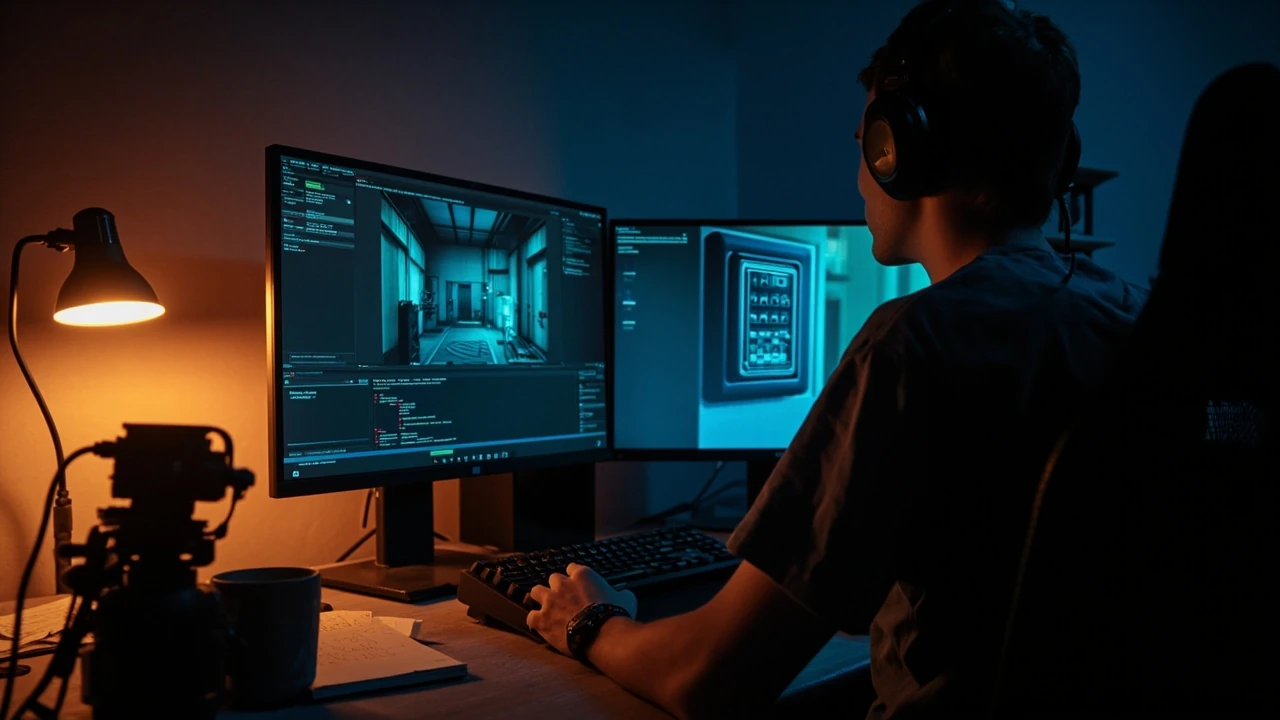
Environmental puzzle design is one of the quieter disciplines in game development, but the patterns that surround a single locked safe tend to influence how players feel about an entire location. The monitor control room safe code, where a combination is hidden somewhere inside a security camera feed or operator terminal, has become a reliable tool for teaching observation, rewarding careful exploration, and pacing the reveal of a level’s deeper secrets. This guide is written for developers and designers who want to understand the pattern well enough to either build, evaluate, or extend it inside a real project.
Rather than a single recipe, the pattern is a family of related techniques. The combination can be hidden in a static image, a rotating CCTV display, a procedural log, a corrupted data tape, or a hand-placed note that requires the player to look back at the monitor at a specific moment. The mechanics, scripting considerations, accessibility implications, and playtesting practices around those variants share enough common ground that treating them together is useful, even though each project will need its own balance.
The article is organized so a developer can read it once and then refer back to the section that matches the next decision on their task list. You will find a structural breakdown of the pattern, a walkthrough of the most common implementation approaches, a side-by-side comparison of hiding strategies, a practical look at the trade-offs the pattern introduces, and a checklist of validation steps before a build is signed off. The piece ends with a FAQ that answers the most common questions that come up in code reviews and design reviews when this kind of puzzle is on the table.
Monitor control room safe code in environmental puzzle design
The monitor control room safe code is an environmental puzzle pattern in which a numeric or alphanumeric combination needed to open a safe is communicated to the player through one or more display surfaces inside a security or control room. The display surface is usually a CRT monitor, CCTV bank, oscilloscope, scrolling log, or operator terminal. The combination itself may be read directly from a frame, deduced from a sequence of events, or assembled by cross-referencing the monitor with another prop in the room.
Designers like the pattern because it lets a level communicate information through space rather than through dialogue or UI overlays. The room itself becomes the clue. The player’s reward is twofold: a sense of having read the environment correctly, and a tangible loot gain when the safe opens. Because the combination is embedded in a piece of world art, it also photographs well, which makes the moment naturally shareable in community clips and walkthrough content.
From a development perspective the pattern is also valuable because it is a small but complete design problem. It touches level art, scripting, UI, audio, accessibility, and QA in a single contained object. That makes it a useful case study when a team is establishing its conventions for environmental storytelling, even in projects that are not puzzle-heavy.
Why the pattern keeps appearing in action, horror, and stealth games
The pattern recurs across genres because it fits several gameplay verbs at once. It rewards players who slow down and look at background detail, which suits horror and survival games that need to control pacing. It produces a discrete objective with a clear success state, which suits stealth and tactical shooters that need self-contained side goals. It supports the narrative idea of a monitored facility, which suits thriller and cyberpunk settings without requiring extra exposition.
For developers, the pattern also slots neatly into existing content pipelines. A control room already justifies monitors, which already justify code, which already justifies a safe, which already justifies loot. Each step is a small addition to an environment that the level already needs, so the cost of the puzzle is often only the scripting and the additional art pass.
Core structural elements of the puzzle
Every working instance of the monitor control room safe code pattern shares a small set of structural elements. They are not all visible to the player, and not all of them need to be equally prominent, but the puzzle tends to feel incomplete if any one of them is missing or handled inconsistently. Thinking of the puzzle as a stack of responsibilities makes the design and the implementation easier to scope.
The structural elements are: a room with a clear monitor surface, a source of the code itself, a player-readable representation of that source, a safe or lock that accepts the code, a feedback loop when the code is correct or incorrect, and a reward. Each of these has a handful of common variations, and the choices made in one element tend to constrain the others. For example, hiding the code in a static image makes the safe feedback loop simpler but pushes more responsibility onto the player’s observation skills.
Monitor surface types and what they imply for the designer
The first decision is what kind of monitor surface displays the code. Each option has different implications for art, scripting, accessibility, and performance. The choice should follow from the setting and from the type of attention the designer wants the player to pay, not from a default that the engine suggests.
The most common surface types are CRT monitors showing static images, CCTV banks cycling through several feeds, operator terminals with multiple lines of text, oscilloscopes with a moving trace, and data tape reels with rolling characters. Each surface can be a fully art-driven prop, a UI canvas in world space, or a hybrid where the prop carries a screen-space render texture.
The decision also affects how the puzzle reads on a streaming or recording setup. A static image on a CRT reads instantly from a thumbnail. A CCTV bank requires the player to remember the right frame, which reads less well in a clip and may need on-screen prompts. A terminal log reads well in screenshots but tends to be missed by players who do not read every line.
| Surface type | Implementation cost | Cognitive load on the player | Accessibility considerations | Best fit |
|---|---|---|---|---|
| Static CRT image | Low | Low | Needs text size or color contrast checks | Tutorial rooms, early-game safe codes |
| CCTV bank cycling feeds | Medium | Medium to high | Needs dwell time on each feed, pause option | Mid-game observation puzzles |
| Operator terminal log | Low to medium | Medium | Needs screen reader or log export consideration | Hacker, cyberpunk, investigation settings |
| Oscilloscope trace | Medium to high | High | Often visual only, may need a second channel | Hard sci-fi, audio-driven puzzles |
| Data tape reel | Medium | High | Needs clear framing and readable type | Retro or archive settings |
None of these surfaces is strictly better than the others. The right choice is the one that fits the room, the player’s expected attention budget, and the team’s ability to maintain the asset through the rest of the project.
Source of the code: diegetic versus metadiegetic
The combination can be diegetic, meaning the code exists inside the world and the player reads it through the monitors, or metadiegetic, meaning the code is presented to the player through an interface that the character cannot see. The pattern is most effective when it leans diegetic, because the player feels they are solving a problem inside the world rather than completing an interface prompt. The moment the code appears in a non-diegetic popup, the puzzle starts to feel like a generic key-and-lock interaction with extra steps.
A useful middle ground is the partial diegesis, where the code appears in world but is reinforced through a UI element such as a journal entry or a codewheel. This keeps the world consistent while still giving the player a backup if they missed a detail. Designers should treat any such backup as a deliberate choice, because it changes the difficulty profile of the puzzle and should be balanced rather than left as an accident of the UI system.
How to implement the pattern in a real project
Implementation is where the pattern either pays for itself or becomes a source of bugs. The most reliable approach is to keep the puzzle logic in a small dedicated component, treat the monitor and the safe as data sources rather than as one tightly coupled object, and expose the relevant fields to designers so the level team can adjust difficulty without writing new scripts. The exact engine matters less than this separation of concerns.
Most teams will end up with three pieces: a code source, a code display, and a code consumer. The code source holds the combination. The code display reads from the source and presents it in a way the player can see. The code consumer, the safe or lock, compares the player’s input against the source and emits a result event. Keeping the source as the single point of truth prevents the common bug where the monitor and the safe fall out of sync after a content change.
Setting up the code source
The code source is typically a serializable component, a data asset, or a scriptable object, depending on the engine and project conventions. It exposes the combination as a string or an array of integers, along with a small set of flags such as whether the code is randomized on load, whether it is unique per save, and how the player should be allowed to enter it. The source should not know about specific monitors or specific safes. It is a piece of level data, not a piece of gameplay logic.
For projects that support randomization, the source should expose a seed or a generation method rather than a baked-in string. The level team can then mark a code as random per playthrough, random per area, or fixed. This single switch covers a surprising amount of design variety without any further engineering work.
Driving the monitor from the code source
The monitor is a presentation layer. It reads from the code source and renders the combination in a way that matches its art and its narrative role. A CRT monitor might display a single static image that an artist prepared with the baked-in code. A CCTV bank might cycle through several feeds and show the code briefly on one of them, timed to a fictional event. A terminal log might scroll the code into view as part of a longer operational report.
From a scripting standpoint the monitor should be parameterized by a reference to the code source and a presentation mode. The presentation mode controls whether the code is shown directly, hidden inside a larger display, or only revealed under a specific condition. The same component can then be reused across many rooms with different settings, which keeps the project maintainable as the level count grows.
Hooking the safe or lock to the code source
The safe or lock is the consumer. It reads from the same code source as the monitor, so the two cannot drift out of sync, and it listens for player input. The input can come from a keypad, a rotary dial, a puzzle interface, or a more elaborate interaction. The safe’s feedback loop is independent of the monitor: a click, a beep, a light, an unlock animation, and a loot spawn. The feedback should be a discrete event the audio and animation systems can react to, so that the rest of the team can polish the moment without touching the puzzle logic.
If the puzzle has variants, such as a wrong code producing a lockout or an alarm, those variants should be implemented as additional states on the same consumer rather than as a separate puzzle object. Lockouts, in particular, are a place where designers and engineers often disagree. A common compromise is to expose a soft lockout that emits a feedback event without disabling the safe, leaving the final tuning to the design team.
| Implementation layer | Owns | Should not own | Typical artist or engineer role |
|---|---|---|---|
| Code source | Combination, randomization, persistence | Visual presentation, input handling | Engineer or technical designer |
| Code display (monitor) | Presentation mode, timing, framing | Player input, success logic | Technical artist, environment artist, UI engineer |
| Code consumer (safe) | Input handling, success and failure events, loot | How the code is shown | Engineer, gameplay designer, audio designer |
This three-layer model scales well because each role has a clean place to work. Artists iterate on the monitor without touching the safe, designers tune the safe without touching the monitor, and engineers can refactor the source without touching either.
Comparing common ways to hide the code
Hiding the code is the part of the pattern that designers argue about most. A good hiding method should feel fair, look natural in the room, and produce a clear moment of recognition. A bad one either gives the code away immediately or makes it impossible to find without a guide. The right answer depends on the player’s expected attention budget and on how the puzzle fits into the surrounding level.
The most reliable approaches fall into four families: direct display, contextual display, environmental cross-reference, and timed reveal. Each has strengths and limitations, and each pairs better with some room types than others. Mixing families within a single project is fine, but mixing families within a single puzzle tends to confuse the player about what the rule of the room is.
Direct display: code visible on the monitor
The simplest approach is to place the code directly on the monitor surface, either as readable text or as a numeric display. This works well for tutorial rooms, for early-game safes, and for situations where the safe is the primary objective of the space. The risk is that direct display is too easy for experienced players, who will simply look at the first monitor they find and move on. Designers compensate by adding decoy monitors with non-code information, so the room still feels populated and worth exploring.
Direct display also raises the bar on typography and contrast. A code that is hard to read because the font is too thin, the screen is too dark, or the text color clashes with the background will frustrate players. This is a place to spend a disproportionate amount of QA time, because the difference between a satisfying read and a frustrating one often comes down to a few pixels of contrast.
Contextual display: code implied by what is on screen
Contextual display hides the code inside something that looks like normal screen content. A CCTV feed might show an office door with a number on it. A terminal log might list four employee IDs, and the code is the last digit of each. A radar screen might show four blips whose grid coordinates form the combination. The player has to interpret the screen, not just read it.
This approach is the workhorse of mid-game observation puzzles because it scales well. Designers can produce many such puzzles by changing the screen content and the interpretation rule. The main risk is ambiguity. If two different interpretations of the screen are plausible, the puzzle becomes a guess. QA’s job is to find any room where more than one reading of the screen produces a valid combination, even by accident.
Environmental cross-reference: code is split across the room
In this family, no single monitor contains the full code. Instead, several props in the room contribute a digit or a symbol each, and the player has to combine them. The monitor might show which prop to look at, the order in which to read them, or a condition that determines which prop is the right one for each slot. The classic form is a series of clocks, calendars, or framed photos whose values map to a digit.
Environmental cross-reference is the most space-efficient way to make a puzzle feel substantial without requiring a long terminal log. It also gives the level art team a lot of room to show off. The cost is a higher chance of the player missing one of the props, which means the puzzle should have a generous hint system or a forgiving input order.
Timed reveal: code is only visible for a moment
Timed reveal is the highest-skill variant. The code appears on the monitor for a short window tied to a narrative event: a sweep of a CCTV camera, a power blip, a transmission from a distant station, a rotating antenna. The player has to be looking at the right place at the right time, or they will need to replay the moment.
Timed reveal produces some of the most satisfying puzzle moments in the genre, but it is also the variant that produces the most walkthrough searches. The design team should make the cue obvious enough that an attentive player will catch it on the first or second attempt, and should consider whether the code can be re-triggered without a full replay of the surrounding sequence. A skip or replay option in the pause menu is a common compromise that preserves the moment without punishing the player.
| Hiding method | Difficulty for attentive players | Difficulty for casual players | Replay value | Risk of walkthrough lookups |
|---|---|---|---|---|
| Direct display | Low | Low | Low | Low |
| Contextual display | Medium | Medium to high | Medium | Medium |
| Environmental cross-reference | Medium to high | High | Medium | High |
| Timed reveal | High | Very high | High on first attempt | Very high |
The right method is rarely the hardest one. A team that wants players to feel smart should choose the method that matches the player’s available attention, not the method that impresses the design team in isolation.
Design trade-offs and balancing the moment
The pattern looks small, but it sits on top of several design decisions that have outsized effects. Difficulty, pacing, narrative tone, accessibility, and replay value all pull on the same small object. The trade-offs below are the ones that come up most often in design reviews, and they are worth thinking about before the puzzle is implemented rather than after.
For most teams, the right approach is to make a deliberate choice for each trade-off, write the choice down, and then enforce it in QA. Leaving a trade-off to chance is how a level ends up with one safe that is too easy and another that is unfairly hard, even though both were built from the same template.
Difficulty curve and where the puzzle sits in the level
The puzzle’s difficulty should track the player’s expected competence at that point in the game. Early safes should use direct display, late-game safes can use timed reveal. The danger is the middle of the game, where the player has learned the conventions but is not yet skilled, and a contextual or cross-reference puzzle can feel either obvious or unfair depending on the specific room. Designers can use the density of surrounding content to set the player’s expected attention. A room with many props signals that observation matters; a sparse room signals that the safe is the focus.
A useful check is to ask whether the puzzle can be solved in the time the player is expected to spend in the room. If a player is likely to spend two minutes in the room, the puzzle should be solvable in about two minutes by an attentive player, including the time to read the monitors and input the code. If it takes longer, either the room needs more affordances or the puzzle needs a more forgiving structure.
Pacing and the cost of the moment
Every safe is a small interruption to the main flow. The player has to stop, look at the monitors, think, input the code, and then claim the loot. The cost is small per safe, but several safes in quick succession can turn a level into a parade of locks. Designers should space safes far enough apart that each one feels like a destination, and should consider whether the loot inside is interesting enough to justify the interruption.
The pacing problem is also affected by how the code is communicated. A contextual display takes longer to read than a direct one, so the pacing cost is higher. A timed reveal can interrupt the main flow if it requires waiting for an event. None of these are reasons to avoid the variants, but they are reasons to be intentional about the placement.
Accessibility, color, and input
Accessibility is not an add-on. Several decisions in this pattern have direct accessibility consequences. The contrast between the code and the screen background is one. The size of the code, especially on small CRT screens, is another. The color choices for CCTV feeds and oscilloscope traces can be a problem for players with color vision deficiency, especially if the code is encoded in a color rather than in a shape or a position.
For players who cannot or do not want to read the code from the monitor, the team should consider whether a backup channel is appropriate. Options include a journal entry that records the code once it has been seen, an audio cue that reads the code aloud, or a contrast mode that boosts the monitor’s readability at the cost of art fidelity. Each option has a cost, and the team’s accessibility review should decide which options are present in the final build.
Input accessibility matters too. A keypad that requires a precise mouse click excludes players on controllers, and a rotary dial that requires a steady hand can be hard for players with motor impairments. The team’s accessibility review should consider whether the input method can be remapped or simplified without breaking the puzzle.
Replay value and randomness
Replay value comes from two sources: random codes that change between playthroughs, and meaningful choices about which safes to open. The monitor control room safe code pattern supports both, but they pull in different directions. Random codes add variety but make walkthroughs and guide videos harder to maintain. Meaningful choices require the loot to be worth the cost of opening the safe, which is a balance the level economy has to support.
For most projects, a hybrid is appropriate. A subset of safes, perhaps the most prominent ones, have fixed codes so that guide content can be produced reliably. The rest can be randomized. Designers should avoid randomizing codes in puzzles that the player is likely to revisit, such as a New Game Plus mode, unless the code source is wired to the save system in a way that keeps the same code attached to the same playthrough.
Playtesting, debugging, and validation
Validation is where the pattern either earns its keep or reveals its costs. The goal of validation is to confirm that the puzzle is solvable by an attentive player, that the code is presented clearly, that the safe responds correctly, and that the moment reads well in motion. The steps below cover the most common failure modes and the cheapest way to catch them before the build reaches a wider audience.
A good rule of thumb is that the puzzle should be tested in three states: a fresh save with the player arriving at the room for the first time, a save where the player has just entered an incorrect code, and a save where the player has already opened the safe and the room needs to behave sensibly on a second visit. Each state exposes a different category of bugs.
First-visit validation
On a first visit, the team should verify that the player can see the monitor, read the code, and reach the safe without backtracking through a closed door or a triggered event. Designers often overlook doors that lock after a certain trigger, which can strand the player in a room with a code they cannot use. A simple walkthrough with a fresh save catches this quickly.
The team should also verify that the code is the same value at the source, at the display, and at the consumer. This is the single most common bug in the pattern, and it is usually introduced by a content change to the monitor that the safe’s data was not updated to match. A small automated check, or even a manual cross-reference in a spreadsheet, is enough to keep the three layers in sync.
Incorrect-input validation
On a save where the player has just entered an incorrect code, the team should verify the feedback. A click, a beep, a denial animation, and a reset to the entry state are the typical components. The team should also check whether the safe has a lockout, and if so, whether the lockout is communicated clearly and whether the player has a way to recover. Lockouts that do not communicate themselves are a common source of player confusion.
Edge cases around input are common. A player who enters a partial code and then walks away, then returns and enters the rest, should be handled consistently. A player who enters the code in the wrong order, if order matters, should receive a clear error. These cases are cheap to script and expensive to discover in production.
Second-visit validation
On a second visit, the team should verify that the room still makes sense. A monitor that still shows the code after the safe is open is fine, but a monitor that displays a contradictory message, such as the safe still being locked, can confuse the player. A safe that resets to a fresh locked state can be fine for replayability but should be intentional. The team should also check whether the loot respawns, and whether that is the intended behavior.
A second-visit pass is also a good place to check audio continuity. A monitor that was emitting a hum while the code was visible should not suddenly go silent, and a safe that emitted a click on open should not still be clicking on a second visit. These small audio bugs are easy to miss and easy to fix, but they accumulate across many rooms.
Common bug patterns to watch for
Across many projects, the same handful of bugs appear in this pattern. Listing them explicitly makes them easier to look for during QA. None of them are catastrophic on their own, but each one degrades the player’s trust in the world, which is the most valuable asset this kind of puzzle has.
- The code shown on the monitor does not match the code the safe accepts, usually because the safe’s data was not updated after a monitor change.
- The monitor shows the code but the safe is on a different floor or behind a one-way door, so the player cannot use the code without reloading.
- The code is randomized per session but the safe reads from a baked value, producing a code that never opens the safe.
- The code is timed, but the trigger event is also timed, and the two timings drift apart when frame rate changes.
- The code is readable in the editor but illegible in the shipping build, because a post-process effect was applied after the monitor’s render texture was set up.
- The safe is solvable on keyboard but not on controller, because the input method was not remapped.
- The safe’s audio cue plays at full volume even when the player has lowered the monitor’s volume, because the audio bus was not set up consistently.
Each of these is a known shape. QA can look for the shapes instead of trying to find the bugs by accident, which is faster and more reliable than ad hoc testing.
Working with other systems in the project
The monitor control room safe code pattern does not live in isolation. It interacts with save systems, progression systems, economy systems, narrative systems, and accessibility settings. A clean integration is the difference between a puzzle that feels like a natural part of the world and a puzzle that feels like a foreign object dropped into a level.
The integrations below are the ones that most often need attention. They are not all required for every project, but each one should be considered at design time. The cost of an integration is usually small, while the cost of a missing integration is often a confusing player experience or a balance problem later in the project.
Save and persistence
If the code is randomized per playthrough, the project should make sure the code is persisted with the save. Otherwise, a player who reloads a save will get a different code and be unable to open the safe. The code source should expose a serialization interface, and the save system should include the code in the snapshot. A common approach is to store the seed rather than the resulting code, which keeps the save small and lets the source regenerate the code on load.
For fixed codes, the integration is simpler, but the team should still make sure that the safe’s state, such as whether it has been opened, is persisted. A safe that the player has already opened should stay open across reloads. The save system should treat the safe’s state as a piece of progress data rather than as a piece of world data.
Progression and gating
The safe is sometimes used as a soft gate, where the loot inside is required for a later challenge. In that case the project should make the dependency explicit. The level designer should be able to mark a safe as required, and the progression system should respond if the player has not opened the required safes by a certain point. A soft warning is usually better than a hard block, because a hard block can leave the player stranded with no clear next step.
The team should also consider the inverse case, where a safe contains a reward that is not required for any challenge. In that case the safe is a side objective, and its presence should not slow the player’s main progress. Designers can use the loot’s value, the room’s accessibility, and the puzzle’s difficulty to signal the side-objective status.
Economy and loot
The loot inside the safe should be tuned as part of the project’s economy, not as a one-off gift. If safes contain high-value loot, the player will start to expect every safe to be worth opening, which raises the cost of designing the rooms and may require more puzzles than the level can support. If safes contain low-value loot, the player may stop opening them, which makes the puzzles feel pointless. The economy team should be involved in the tuning, just as they would be involved in tuning any other reward.
The team should also decide how the loot is presented. A safe that opens to reveal a pile of generic currency feels different from a safe that opens to reveal a single named item, even if the items have the same economic value. The presentation is part of the reward, and the team should treat it as such.
Narrative and environmental storytelling
The monitor and the safe are pieces of environmental storytelling, and the team should make sure the story they tell is consistent with the level’s narrative. A monitor that displays a code for a safe that contains contraband suggests one story. A monitor that displays a code for a safe that contains personal mementos suggests another. The story does not have to be explicit, but it should not be contradictory.
For narrative-heavy projects, the team can use the safe and the monitor as a small scene in their own right. A note next to the safe, a voice log, a scribble on a whiteboard, or a half-erased whiteboard message can all add to the story without adding much to the puzzle. These small touches are often the difference between a puzzle that the player remembers and a puzzle that the player solves and forgets.
Accessibility and player guidance
Accessibility considerations for the monitor control room safe code pattern can be grouped into three areas: visual, motor, and cognitive. Each area has a few specific decisions that have outsized effects on whether the puzzle is playable for a given player. The decisions below are not exhaustive, but they cover the most common failure modes.
The team’s accessibility review should treat the puzzle as a single object, not as a collection of independent features. A change in one area often affects the others. For example, increasing the contrast of the code helps players with low vision but can change the art direction of the room, which in turn affects the narrative.
Visual accessibility
Visual accessibility for this pattern centers on the readability of the monitor. The code should be clearly separated from the surrounding content, with enough contrast and size to be read at the player’s chosen resolution. The team should provide at least one high-contrast preset, and should test the preset on the smallest monitor and the largest monitor in the game to make sure it works at both ends.
Color is a special case. If the code is encoded in color, the puzzle will be inaccessible to players with color vision deficiency. The team should avoid this encoding, or should provide a secondary encoding that does not depend on color. A common approach is to use position, shape, or texture in addition to color, so the puzzle remains solvable in any color setting.
Motor accessibility
Motor accessibility for this pattern centers on the input method. The safe should accept input from the primary input device the player is using, whether that is a keyboard, a controller, a touch screen, or an adaptive controller. The team should make sure the input method can be remapped, and should provide a slow or assisted mode if the default requires fast or precise input.
The team should also consider the player’s movement around the room. A safe that requires the player to move quickly between the monitor and the safe may exclude players with slower movement speeds. A room that is too small for a wheelchair or a controller with a wide base is also a problem. The level design should account for the player’s likely movement range.
Cognitive accessibility
Cognitive accessibility for this pattern centers on the clarity of the puzzle. The player should be able to tell, at a glance, which object is the safe, which object is the monitor, and what the relationship between them is. The team should avoid puzzles that require the player to remember a long sequence of digits, and should provide a way to re-read the code if the player needs to. A pause menu that allows the player to revisit the monitor is a common solution.
The team should also consider the player’s expected familiarity with the pattern. A player who has seen the pattern before can solve a direct-display puzzle in seconds. A player who has never seen the pattern may need a hint. The team should provide hints for the first instance of the pattern in the project, and can skip hints for later instances if the player has demonstrated familiarity.
Performance, build cost, and pipeline considerations
The pattern is small, but it is also a place where several systems meet, and a small inefficiency in each system can add up. The performance considerations below are the ones that have the largest effect on frame time, memory, and build duration, in roughly that order of importance.
The team should profile the pattern in the same conditions as the rest of the level, not in isolation. A monitor that costs one millisecond when measured alone may cost three milliseconds when measured next to a full lighting pass, and the difference can affect whether the project holds its target frame rate on the target hardware.
Frame time and draw cost
Each monitor is a prop, and each prop contributes to the scene’s draw call count. The team’s optimization pass should look at the number of monitors in a single room, the materials used, and whether the monitors are visible from the player’s typical position. A monitor that the player never sees is still a draw call. Designers can mark distant monitors as not casting shadows, and the rendering team can use impostors for monitors that are far from the camera.
The code display itself can be a significant cost if it is implemented as a screen-space UI element rather than as a world-space material. A world-space material is usually cheaper, because it is part of the prop’s regular draw call. A screen-space UI element is rendered separately, and can become a bottleneck if the room has many monitors. The team should choose the implementation that matches the level’s target frame rate.
Memory and texture budget
Each unique monitor texture is a piece of memory. A level with many unique monitors can blow the texture budget, especially on memory-constrained platforms. The team should reuse textures where possible, by rotating a small set of monitor displays across many rooms. Designers should avoid the temptation to make every monitor unique, because the visual gain is usually small and the memory cost is real.
The team should also consider the cost of any animation that runs on the monitor. A monitor that displays a static image is cheap. A monitor that runs a short looping video is more expensive, especially if the video is decoded on the CPU. The team should consider whether the loop is necessary, and whether it can be replaced with a more efficient effect.
Build duration and content iteration
The pattern has a content iteration cost that is easy to underestimate. Each new monitor is a new asset that has to be authored, imported, and reviewed. The team should make the asset pipeline as smooth as possible, so designers can iterate on monitor content without waiting for a long import. A template-based approach, where the monitor is a parameter on a shared prefab, is usually faster than a one-off approach.
The team should also make sure the safe and the monitor are linked in the level editor in a way that designers can see. A designer who is changing a monitor’s content should be reminded to update the safe’s data, and a designer who is changing a safe’s code should be reminded to update the monitor. The reminder can be a comment, a naming convention, or a tool that scans for mismatches. The goal is to catch the bug before QA, not after.
Production checklist before the build is signed off
The list below is a practical checklist that a small team can run through before a build is signed off. It is not exhaustive, but it covers the most common failure modes. The team should adapt it to the project’s specific conventions and to the platform’s specific constraints.
For larger teams, the checklist can be split between disciplines, with each discipline owning the items that fall under its responsibility. The items that span disciplines should be assigned to a producer or a lead, who can chase down any gaps.
- Code source, monitor display, and safe consumer reference the same combination value and are wired through a single point of truth.
- Code presentation is legible at the player’s chosen resolution, with a high-contrast preset available.
- Code does not rely on color alone; position, shape, or texture provides a secondary encoding.
- Code input is remappable to keyboard, controller, and any other supported input method.
- Code randomization is persisted with the save, and randomized codes regenerate on load.
- Code timing is robust to frame rate changes, and any triggered events use a stable timing source.
- Safe’s success and failure events are exposed as discrete events for audio, animation, and UI systems.
- Safe’s lockout behavior, if any, is communicated clearly and has a recovery path.
- Loot inside the safe is tuned as part of the project’s economy, and is appropriate to the room.
- Room is reachable on a fresh save, and the safe is reachable from the monitor without crossing a one-way trigger.
- Room behaves sensibly on a second visit, including audio, monitors, and any scripted events.
- Monitor assets fit within the project’s texture and draw call budgets on the target hardware.
- Build duration is not significantly affected by the number of unique monitor assets in the level.
- Accessibility review has signed off on visual, motor, and cognitive accessibility for the puzzle.
Running through this list once before a major milestone is usually enough to catch the majority of the bugs that would otherwise surface in the wild. The items that fail are also a good signal of which systems need more attention in the next iteration.
Frequently asked questions
What is the monitor control room safe code pattern in game design?
The monitor control room safe code pattern is an environmental puzzle in which a numeric or alphanumeric combination needed to open a safe is displayed somewhere on a monitor, CCTV bank, or operator terminal inside a security or control room. The pattern is used to reward observation and to make the room itself the source of the clue, rather than relying on dialogue, UI prompts, or external handouts.
Which genres benefit most from this puzzle pattern?
The pattern fits horror, survival, stealth, tactical shooters, and cyberpunk or investigation settings especially well, because those genres already justify a controlled space with monitors. It also works in adventure games and walking simulators, where the player’s main verb is observation. Action games can use the pattern as a side objective, provided the pacing cost of stopping to read a monitor is acceptable.
How should the code be presented to the player?
The code can be presented directly on the monitor, embedded in contextual content, split across several props in the room, or revealed only at a specific moment. The right choice depends on the player’s expected attention budget and on the puzzle’s position in the difficulty curve. A direct presentation is best for early safes, while a timed reveal is best for late-game safes that need to feel earned.
What is the cleanest way to script the pattern?
Split the puzzle into three pieces: a code source that holds the combination, a code display that reads from the source and renders the combination on the monitor, and a code consumer, usually the safe, that reads from the same source and handles player input. Keeping the source as the single point of truth prevents the most common bug, in which the monitor and the safe fall out of sync after a content change.
How can the pattern be made accessible to players with low vision?
Provide a high-contrast preset, increase the size of the code, and avoid encoding the code in color alone. Add a backup channel such as a journal entry or an audio cue that reads the code aloud, and make sure the backup is intentional rather than accidental. Test the high-contrast preset on both the smallest and the largest monitor in the game, and on the target hardware’s typical viewing distance.
How should randomized codes be handled in a save system?
Store the seed for the code with the save, and let the code source regenerate the combination on load. This keeps the save small and lets the same save always produce the same code. A baked-in random string stored in the save also works, but takes more space and is harder to update if the generation algorithm changes later in the project.
What is the most common bug in this pattern?
The most common bug is a mismatch between the code shown on the monitor and the code accepted by the safe, usually introduced when a designer updates the monitor’s content without updating the safe’s data. The cleanest prevention is to wire both to a single code source, so any change to the source updates both at once. A pre-commit or pre-submit check that compares the two values is a useful second line of defense.
Can the pattern work without an explicit safe?
Yes. The same code source and display pair can drive a door, a container, a computer terminal, or any other lock that accepts a combination. The pattern’s value is in the monitor as a clue, not in the safe as a container. Many projects use the monitor with a door or a terminal to vary the reward structure and to keep the player from assuming that every monitor leads to a safe.
How much performance overhead does the pattern add?
The pattern is small in isolation, but it scales with the number of monitors in a single room. Each monitor is a draw call, and each unique monitor texture is a piece of memory. A level with many unique monitors can blow the texture budget on memory-constrained platforms. The team should reuse textures, use impostors for distant monitors, and prefer world-space materials over screen-space UI for the display itself.
What is the best way to teach the player the pattern?
Use the first instance of the pattern as a tutorial. Place the safe and the monitor in the same small room, present the code directly, and keep the code short. A simple first instance teaches the player the convention, and later instances can use the more complex variants. Designers should avoid putting a hard puzzle early in the project, because a confused player is less likely to engage with the rest of the level.




Leave a Reply