

Green Prince Silksong: who he is and why players keep asking
Searches for green prince silksong have picked up as Hollow Knight: Silksong moves through its long development cycle, because the sequel has hinted at a royal court of moths, weavers, and forgotten heirs living above and below the kingdom of Pharloom. The phrase itself is not an official character name confirmed by Team Cherry in a single press line. It is a player-coined label that pulls together a small handful of teasing details: a green-and-bronze figure glimpsed in early footage, regal posture, and a design that reads as both ceremonial and slightly decayed. Players arriving at the phrase want to know whether the character is real, what role he plays in the story, and how he might connect to the established Hollow Knight lore of Pale King, White Lady, the Five Great Knights, and the kingdom of Hallownest.
This guide is written for a player or lore-curious reader who wants a careful, evidence-based picture rather than a recycled rumor list. It pulls together what has actually been shown, what has been implied in interviews and demo footage, and where the gap between speculation and confirmation still sits. The political and biological setting of Pharloom matters here, because the only reliable way to read a partly-seen character is to read the world the developers have already built around him.
Where the name “green prince” actually comes from
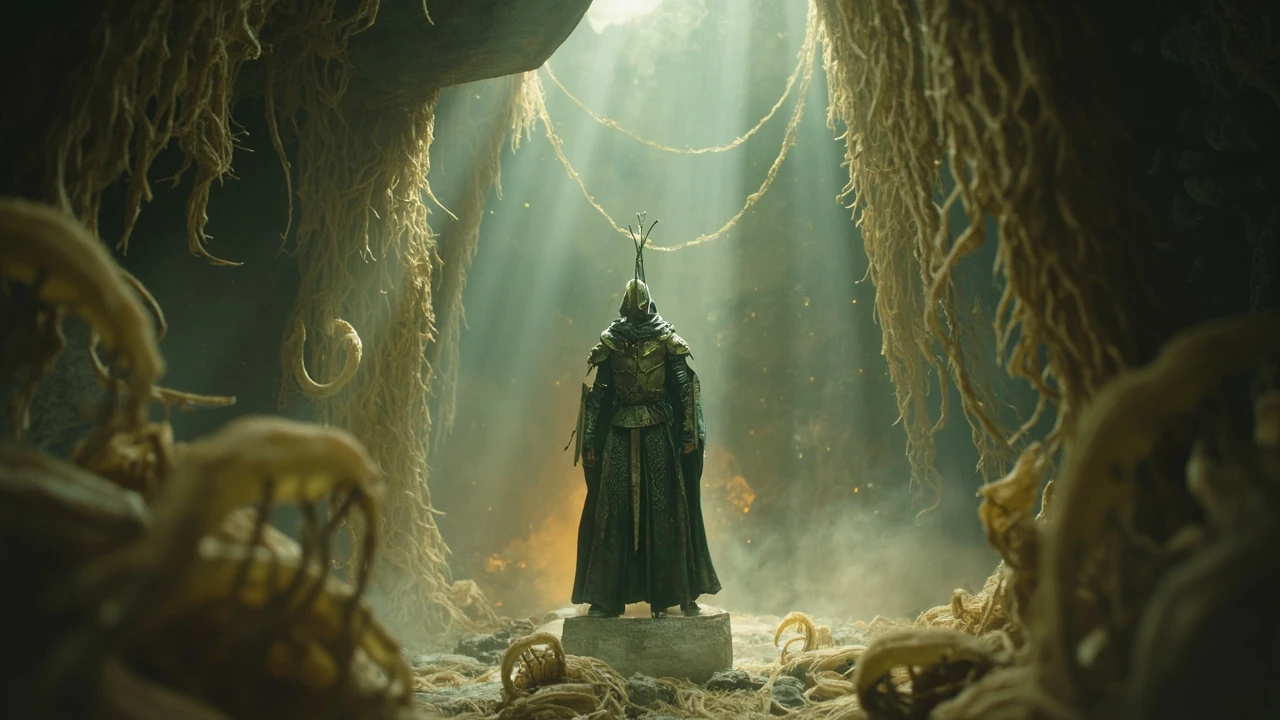
The term green prince silksong is a fan nickname. It does not appear in any Team Cherry blog post, in the Steam page copy, or in the E3 2019 reveal trailer’s on-screen text. The nickname grew out of community pattern recognition: a still frame from the early Silksong demo showed a tall figure in layered green and bronze plate standing at the edge of a crowd, with a posture and silhouette that contrasted with the more ragged, bug-like NPCs in the same clip. Fans looking for a regal counterpart to Hornet’s agile fighter archetype latched onto the green palette and the upright stance and called the figure a prince.
That kind of nickname is normal in the Hollow Knight community. The “Pale King,” “White Lady,” “Radiance,” and “Grimm Troupe” labels all began as community shorthand before the developers either adopted them or confirmed the underlying characters through later updates. The first expansion, The Grimm Troupe, was even named by the developers after the fan label had already taken hold. So the existence of a community nickname is not a sign that the character is fictional. It is also not confirmation that the nickname will survive into the final game. Until Team Cherry uses a name in shipping copy, anything a player says about who the “green prince” is should be treated as one possible reading of a still-evolving design.
The visual evidence in trailers and demos
The clearest piece of evidence is the 2019 trailer and the demo footage that followed. In the earliest Silksong trailer, a green-and-bronze figure appears for a few seconds among a crowd watching what looks like a public ceremony. The figure wears layered, almost ceremonial armor in shades of oxidized copper and moss-green, with a tall, narrow helm that conceals most of the face. The pose is calm, upright, and slightly aloof. The crowd around him moves with more erratic, insect-like motion, which makes the figure feel more composed and possibly more authoritative.
A few details are visible on screen rather than inferred:
- The figure is taller than most of the surrounding NPCs, with a narrow, elongated silhouette.
- The palette is dominated by green, bronze, and off-white, with no visible pure black.
- The character stands apart from the crowd and is not interacting with the smaller figures around him.
- No weapon is visible in any still frame, which is unusual for a Silksong NPC given how aggressively Hornet is shown in the same footage.
- The surface the figure stands on appears to be the same carved stonework visible in the Citadel area, suggesting an upper-class or governmental district rather than a frontier or industrial zone.
None of these details confirm a name, a faction, or a role. They do narrow the speculative range. A figure standing apart from a crowd, dressed in ceremonial plate, in what looks like a governmental quarter, is unlikely to be a wandering merchant or a low-tier enemy. The most consistent reading is that the figure represents some form of authority in the Pharloom setting, possibly tied to the weaver cult that the marketing has hinted at as a structural power above the city.
How the setting of Pharloom frames a possible royal figure
To understand why a green-robed regal NPC would matter in Hollow Knight: Silksong, it helps to set out the political map the developers have been building. The first Hollow Knight ends with Hallownest sealed beneath the Pale King, the White Lady, and the Radiance in a slow collapse. Silksong moves the camera to a new kingdom, Pharloom, ruled in name by a group called the Weavers and protected, at least at the start of the story, by Hornet. The kingdom is built around silk, song, and a vertically stacked city. Its aesthetic is bright bone, gold, and pale threads, with greens, teals, and rusts used for older or lower districts.
The structure of authority in Pharloom, as shown in the demos, is layered:
- At the top sit the Weavers, a group of powerful, long-lived figures who weave protective and binding threads across the kingdom.
- Beneath them is a civic or religious order, shown in the demos as bell-ringers, choir singers, and armored guards who keep the city’s rituals running.
- Below the civic order is the pilgrim and worker class, the NPCs Hornet moves through when she descends into the lower city.
- At the bottom sits a corrupted or broken layer, with crusted enemies and environmental hazards, suggesting that something in the kingdom is failing or has been left to rot.
A “prince” figure, in this layered setting, would most naturally belong to the upper tier. The name itself suggests a blood relation rather than a religious office. The green palette, set against the predominantly gold and bone tones of the visible Pharloom architecture, makes the figure read as a foreign or older element, like a royal house from a previous era whose aesthetics do not quite match the current regime. That visual mismatch is one of the strongest reasons fans have kept the nickname alive. It is also why the figure looks more interesting than a generic guard captain: the color difference suggests a story, not just a costume choice.
Possible narrative roles for a green royal in Silksong
Because the developers have not confirmed the figure’s identity, the most useful thing a guide can do is map the narrative roles that would fit the visible evidence and the world Team Cherry has already established. The list below is not speculation about a specific person. It is a set of roles the figure could plausibly fill given the kingdom of Pharloom, the structure of the prior game, and the few seconds of footage available.
- Surviving heir of an older house. A prince whose line predates the Weavers’ rule. The green palette would mark him as a different faction, and his distance from the crowd would suggest a withdrawn or isolated status.
- Ceremonial figurehead for the current regime. A royal kept on display by the Weavers, used to legitimize their rule without giving them real power. This would explain the calm posture and the lack of a visible weapon.
- Rival claimant to the throne. A prince who is out of favor with the Weavers, lingering in the city as a quiet threat. The broken or decayed parts of the lower city could tie into a story about a kingdom slowly losing its grip.
- Disgraced or exiled royal. A prince who has been removed from the public court but not killed, with his green armor marking him as something the regime would prefer the pilgrims not to see.
- Bridge character to Hallownest. A figure whose line ties Pharloom back to the older kingdom, allowing the sequel to acknowledge the previous game without recapping it.
Each of these roles would be consistent with Team Cherry’s writing style, which tends to keep major NPCs morally ambiguous until the player uncovers their context. The developers do not usually write clear-cut heroes or villains. They write figures who look one way at a distance and a different way once the player has read the right item description or fought through the right arena. A green prince figure, if he ships in that mold, would be someone whose role shifts as Hornet learns more about Pharloom.
Comparing the visual language to other Hollow Knight factions
Team Cherry uses color, silhouette, and material to signal faction and era. The table below compares what we can see in the demo footage to the visual code of the factions already established in the first game. This kind of comparison does not prove identity. It does show how a fan nickname can survive scrutiny: the figure’s design does not match the most common Silksong silhouettes, which is exactly why players feel it must be doing some narrative work.
| Visible trait | Green prince figure (Silksong demo) | Pharloom guards (Silksong demo) | Weavers (Silksong demo) | Hallownest knights (Hollow Knight) |
|---|---|---|---|---|
| Dominant color | Moss green, oxidized bronze, off-white | Bone white, dull gold, rust | Pale ivory, soft pink, deep red threads | Steel grey, royal purple, tarnished silver |
| Silhouette | Tall, narrow, upright, still | Compact, helmeted, weapon ready | Flowing, multi-limbed, draped | Heavy, broad, plate-armored |
| Material feel | Ceremonial plate, old metal | Functional armor, mass-produced | Soft threads, organic | Hammered steel, carved stone |
| Crowd behavior | Stands apart, does not interact | Patrols, reacts to player | Elevated, often off-screen | Largely absent in the late game |
| Likely narrative role | Royal, exiled, or ceremonial | Civic order, obstacle, or ally | Hidden authority, possible antagonist | Fallen protectors, lore carriers |
The point of the comparison is not to pick a winner. It is to show that the figure’s design language is its own category. He is not a Weaver, not a Pharloom guard, and not a holdover from Hallownest. He looks like a third thing, which is exactly the design space where a hidden royal would sit.
How a “prince” character could affect gameplay
If the figure ships as a real character rather than a background prop, the most important question for a player is what he will actually do. In Hollow Knight, NPCs who look ceremonial turn out to be vendors, quest-givers, dreamers, or boss encounters, sometimes in that order. The green prince figure, given the available evidence, has three plausible gameplay functions.
Quest-giver or information source
The calm, stationary posture and the lack of a visible weapon are consistent with an NPC the player can talk to. Team Cherry has used this pattern for characters such as the Nailsmith, the Seer, and the White Lady. A green prince figure who offers cryptic lines about Pharloom’s history, or who unlocks a particular sub-area, would fit the studio’s preference for NPCs who teach the player through dialogue rather than through tutorial pop-ups. Players who like the reading side of Hollow Knight tend to like this kind of encounter because it rewards attention without slowing the action.
Late-game boss or duel encounter
A royal NPC in a position of visible authority is a natural boss candidate, especially in a game whose marketing emphasizes Hornet’s aggressive combat style. A duel between Hornet and a green prince figure would also fit a recurring Team Cherry pattern: a combat encounter that starts as a polite meeting and ends in a forced fight once a certain condition is met. The design of the figure, with ceremonial plate and a calm posture, would let the developers make the fight feel like a personal confrontation rather than a generic monster battle.
Story pivot or environmental trigger
Some NPCs in Hollow Knight never fight. They change the world when the player talks to them at the right time, or when the player completes an unrelated quest that indirectly affects them. A green prince figure could be a silent witness whose reaction to a late-game event changes the political balance of Pharloom. This is the kind of writing the developers have used most often in the first game, and it would be a natural fit for a character whose visual design already signals quiet authority.
What Team Cherry has actually said, and what they have not
Separating fact from community reading is the most important part of any guide to an unannounced or unconfirmed character. The list below summarizes what the developers have said publicly about Silksong, with notes on what each statement does and does not tell us about a “green prince” figure.
- 2019 reveal trailer. Confirms the kingdom of Pharloom, the protagonist Hornet, and a new quest structure built around bounties. Does not name any specific NPC beyond Hornet and the general term “citizens.”
- 2022 and later demo footage. Shows the Citadel, the Deep Docks, the Greymoor, and additional areas. Confirms new enemy types, new tools, and a larger map. Does not identify any royal figure by name.
- Developer interviews. Team Cherry has described Silksong as a full sequel, not an expansion, and has confirmed that it will not require ownership of the first game. They have not announced a release date, a price, or a content cutoff.
- Store and platform pages. List Silksong as coming soon on Steam, Nintendo eShop, and console storefronts, with the same general feature list carried forward from earlier years. None of them list a character by the name “green prince.”
What this means in practice is that the figure exists as on-screen evidence but not as a confirmed named character. Until Team Cherry publishes a name, an in-game text reference, or a developer statement, the safest position for a guide is to treat the term green prince silksong as a community label for a still partly hidden figure, while keeping open the possibility that the final game will rename, redesign, or remove the character.
Common misconceptions worth clearing up
Because the term is a community nickname built on a few seconds of footage, several misconceptions have built up around it. The most common are worth addressing directly.
- “The green prince is confirmed playable.” He is not. No footage shows the figure in Hornet’s pose, with her movement set, or with any of the tools shown in the gameplay demos. The figure stands still and is filmed from a fixed cinematic angle.
- “The green prince is Hornet’s brother.” The first game established Hornet as the child of the Pale King and Herrah, with no siblings on screen. The developers have not introduced a new sibling, and the term “prince” is a fan label, not an in-game relationship.
- “The green prince is a secret Hallownest refugee.” Plausible, but not confirmed. The visual language overlaps with Hallownest aesthetics, but it also overlaps with several other possible sources, including an older Pharloom house.
- “The green prince is the main villain.” Nothing in the visible design suggests a primary antagonist. The Weavers are a stronger candidate for that role based on the way the marketing positions the kingdom’s hidden authority.
- “The green prince will be a DLC boss.” Silksong has not been announced with DLC at this stage. Any claim about post-launch content is speculation.
These are exactly the kinds of claims a careful guide should not repeat. A reader who arrives at the phrase green prince silksong deserves a clear line between what is on screen, what is implied, and what is rumor.
How to follow the character without burning out on rumors
Players who want to stay current on this character without falling into a rumor cycle can use a small, sustainable approach. The list below is what a careful Silksong follower should track, and what they should ignore.
- Watch official trailers directly. New trailer frames are the only place where the developers’ intent is visible. Community breakdowns are useful, but they are interpretations, not sources.
- Read developer interviews in full. Team Cherry gives long, specific answers. Skimmed quotes tend to lose the qualifiers that change the meaning.
- Save interesting screenshots with their date and source. Screenshots without provenance get attributed to the wrong demo within a few months.
- Treat “leaks” with the same skepticism as rumors. Until a leak is confirmed by the developers, it sits in the same category as fan speculation.
- Revisit the first game’s lore entries. The developers reuse motifs, color codes, and structural roles. Reading Hollow Knight‘s item descriptions is the fastest way to build the vocabulary the new game will assume you already have.
The first game’s story is built for a player who notices small things in the environment and reads the item descriptions when they find them. A reader who can hold a half-known figure like the green prince in their head without trying to resolve every detail will probably get more out of the final game than a reader who chases every rumor to its source.
Useful checkpoints if a future update changes the picture
Any claim in this article can be checked against a small set of future events. When one of these happens, the picture changes and this guide will need an update.
| Future event | What it would change | What to watch for |
|---|---|---|
| Official name reveal | Replaces the community nickname and locks the character’s identity | Press release, store copy, in-game NPC text |
| New trailer or demo | Adds or removes visible traits and may clarify faction ties | Cinematic clips, in-engine footage, official screenshots |
| Release of Silksong | Final confirmation of role, quest status, and combat behavior | In-game NPC text, item descriptions, boss room entry |
| Post-launch patch or DLC | Could add, redesign, or retire the character | Patch notes, devlog entries, new quest entries |
| Developer interview clarifying lore | Resolves speculation by naming the figure’s role | Direct quote from a Team Cherry member |
If a future event moves the character into confirmed territory, the right response is to revisit the original sources and rewrite the relevant sections rather than stack speculation on top of speculation.
How the green prince figure compares to named royal archetypes in the genre
Outside Silksong, several games have used similar visual and narrative cues to introduce a quiet royal figure whose role shifts as the player learns more. The table below compares the green prince silhouette to four of the most common archetypes a player will recognize from other action-platformers and metroidvanias. This kind of comparison does not predict what the developer will do. It helps a reader calibrate what kind of writing and design they should expect from a character who is dressed like royalty, standing apart from a crowd, and not shown with a weapon.
| Archetype | Visual cues | Typical narrative role | Match to the Silksong figure |
|---|---|---|---|
| Exiled heir | Ceremonial armor, foreign palette, distance from court | Reveals hidden history, sometimes becomes playable late | Strong visual match, narrative unconfirmed |
| Figurehead monarch | Calm posture, static presence, formal design | Legitimizes a hidden authority, often powerless | Strong posture match, role not shown |
| Corrupt prince | Decayed or damaged regalia, off-color palette | Late-game boss, environmental trigger | Some palette cues, no decay visible |
| Hidden founder | Older design, off-frame from current setting | Lore anchor, quest-giver for late-game area | Plausible given the design’s older feel |
For a reader who plays a lot of metroidvanias, the most useful mental model is the “exiled heir” archetype, because it is the one that most often lets a developer keep a regal figure interesting without making them the obvious villain. That said, Team Cherry has historically avoided obvious archetypes. The first game’s royalty are not the simple heroes or villains their appearance suggests, and there is no reason to expect the sequel to be different.
A short practical checklist for new players
If a reader is arriving at the term green prince silksong without having played the first Hollow Knight yet, the practical path through the next few months of waiting is short.
- Play the first game before launch if possible. The developers have said Silksong does not require it, but the writing assumes the player is familiar with the Hallownest setting.
- Skim the item descriptions rather than read a lore wiki. Wiki summaries are useful for cross-reference, but the in-game writing is the canonical source.
- Watch the official trailers once, then put them down. A single viewing preserves the surprise of meeting a new character for the first time.
- Keep one open browser tab to the official site. Team Cherry still posts updates on their own site first, and a single tab is enough to catch a new trailer or interview without diving into rumor channels.
- Wait for a name before treating the character as confirmed. Until the developers name a figure, treat the term “green prince” as a useful shorthand, not a fact.
The five-step path is small on purpose. Hollow Knight: Silksong is a long game with a lot of quiet detail, and the best preparation is the first game plus a willingness to read the room when the new one ships.
Limitations of this guide
This guide is built from public trailers, demos, interviews, and community discussion up to the date of writing. It does not have access to a finished build, to developer-only documentation, or to a release date that has not been announced. Several claims in the article are explicitly marked as speculation grounded in the visible evidence, and the rest is built on what has been shown or said in public. If a future trailer introduces a new character, removes the green figure, or names him outright, the relevant sections will need to be revisited against the new source. Readers who want a wider frame for the regal symbolism the design appears to draw from can consult the related overview of the Green Prince narrative concept, which covers a distinct real-world and literary tradition that the in-game design may be echoing.
Frequently asked questions
Is “green prince silksong” an official character name?
No. It is a community nickname built from a still frame in an early Silksong demo that shows a tall, green-and-bronze figure standing apart from a crowd. Team Cherry has not used the term in any official post, store listing, or interview. Until the developers publish a name, the term should be treated as fan shorthand rather than a confirmed identity.
What does the green prince figure look like in the demo?
He is a tall, narrow character wearing layered ceremonial armor in moss green, oxidized bronze, and off-white. The figure stands upright with a still, calm posture and is filmed from a cinematic angle rather than from gameplay. He does not carry a visible weapon, which is unusual for the NPCs shown in the same footage.
Is the green prince a villain, an ally, or a boss?
None of these roles are confirmed. The visual cues are consistent with several possible roles, including a ceremonial figurehead, an exiled heir, a rival claimant, or a bridge character to the older Hallownest lore. The developers have not announced his function in the story or in combat.
Could the green prince be related to the Pale King or the White Lady?
It is possible, but the developers have not said so. The visual language overlaps with the Hallownest aesthetic, which is why fans have suggested the link, but a green palette could also indicate an older Pharloom house whose design predates the current Weavers’ rule.
Will the green prince be playable?
There is no evidence for this. Every gameplay demo released so far has Hornet as the controlled character, and the green figure is shown in a cinematic context. Until the developers add a second playable character to the public marketing, he should not be expected to be playable.
Is the green prince in Hollow Knight: Silksong’s release build?
That is unknown. The character is visible in demo footage, but Silksong has not shipped at the time of writing. Designs sometimes change between demo and release, and the developers have not committed to a public release date.
What is the difference between the green prince and the Weavers?
The Weavers are a group of long-lived figures shown in the demos as the hidden authority above Pharloom, with a visual code built around pale ivory, soft pink, and deep red threads. The green prince figure uses a different palette and stands apart from the crowd, which suggests a different faction or role. Whether that role is friendly, hostile, or unrelated to the Weavers is not yet shown.
Should I play the first Hollow Knight before Silksong comes out?
It is a good idea, though the developers have said it is not required. The writing in the sequel assumes familiarity with the kingdom of Hallownest, the Pale King, the Radiance, and the Five Great Knights. Playing the first game gives a much fuller reading of any reference the sequel makes to those characters.
Where can I find official Silksong updates?
The most reliable source is the official Team Cherry site and the platform store pages. Community channels and wikis are useful for cross-reference, but they should be checked against an official post before being treated as fact.
What is the best way to avoid spoilers while waiting?
Mute keywords in social channels, watch each official trailer only once, and rely on the developers’ own communications for new information. The first Hollow Knight rewards a player who notices small details in the environment, and a similar experience is likely for the sequel. Holding off on speculation is part of that.



Leave a Reply