
Drag drive simulator codes and how redemption systems actually work
A working set of drag drive simulator codes can shave hours off the early grind in Roblox drag-racing experiences, but the redemption system behind them is easy to misunderstand. Players often confuse a “code” with a console command, a server script, or a private developer giveaway, and that confusion leads to expired entries, broken inputs, and the wrong reward tables being trusted. Before chasing the latest list, it helps to understand what a code is in this kind of title, how it is delivered, and how the redemption pipeline is wired in a typical Roblox drag-racing game.
Drag-racing games on Roblox follow a recognizable production pattern. A small team ships a vehicle, a track, and a tuning loop, then layers on live operations in the form of free currency drops, boost refills, livery unlocks, and limited-time events. Codes sit on top of that loop as a marketing and retention tool. They are not part of the core racing simulation; they are a thin client-server channel that grants predefined rewards when a player types a short alphanumeric string into a redeem menu.
This article focuses on the practical side of that channel for players who want to use the codes safely, and for readers who want to understand the design choices behind a redemption system. The verification steps, the timing caveats, and the way rewards map to game progression are all worth understanding because they apply across most drag-racing games on the platform, even when the exact code list changes every patch.
What “drag drive simulator codes” actually redeem
Drag drive simulator codes do not unlock hidden cars, do not bypass the tuning system, and do not modify the simulation in any way. They are fixed strings that the game client sends to a backend service, which then returns a reward payload tied to the requesting account. The reward payload is a list of items, currencies, or boosts that the live-operations team has pre-defined for a given code.
In practice, that means a code might grant a small amount of in-game cash, a fixed number of boost tokens, a livery piece, a wheel cosmetic, or a one-time crate. Some games occasionally fold in event tickets or XP multipliers. The variety is wide because each studio defines its own reward table, but the structure is consistent: input string, server-side lookup, reward list applied to the player profile.
Because the rewards are pre-defined, a code cannot be “upgraded” by typing it twice, by entering it on a different account, or by using a third-party “generator” site. The backend either recognizes the string and returns the payload, or it returns an error. The most common reasons a code fails to redeem are covered later in the troubleshooting section, but understanding this baseline behavior is the fastest way to avoid wasted effort.
A useful mental model is to treat each code as a coupon. A coupon has a printed value, a validity window, and a single redemption per account. It does not stack, it does not compound, and the cashier has no discretion to round it up. The Roblox redemption pipeline is the same kind of mechanical exchange, and the only thing that changes between games is the printed value and the window.
How Roblox drag-racing redemption systems are typically built
Most drag-racing games on Roblox use a standard redemption pipeline that the platform itself supports. A developer creates an in-experience GUI, usually a simple text field with a “Redeem” button, that calls a script on the server. The script receives the string, validates it against a table of active codes stored in a DataStore or a remote configuration, and returns a reward structure that the client applies through standard inventory and currency services.
The DataStore approach is the most common. Each code is stored with a status flag such as active, expired, or single-use, a reward payload, and an optional expiration timestamp. When a player submits a string, the server checks the flag, checks whether the code has already been claimed by that account, and either returns the payload or an error code. The error code is then translated into a friendly message such as “This code has expired” or “You have already used this code.”
A more advanced version of the same pipeline uses RemoteFunctions or messaging services so that the redemption table can be updated without shipping a new build. The development team pushes a configuration change, and the next redemption attempt reads the updated list. This pattern is what allows a game to drop new codes in the middle of an event without forcing a patch.
There is also a small number of studios that use an external webhook, where the player enters the code in a browser, the browser sends the code to a hosted endpoint, and the endpoint writes the reward directly to the player’s profile through Roblox’s Open Cloud API. The browser path is rarer because it adds friction, but it is the pattern most exposed to phishing since the player is asked to log in outside the game client.
From the player’s point of view, all three pipelines look the same: a text field, a submit button, a status line. The internal plumbing only matters when a redemption behaves unexpectedly, and even then the troubleshooting steps are the same. The end state is always a payload applied to the requesting account or an error message that explains why the payload was not applied.
Where players usually find valid drag drive simulator codes
Code distribution is fragmented, and a player who only checks one source will miss a large share of available entries. The most reliable channels, ranked by frequency of legitimate drops, are the developer’s official social media accounts, the game’s official Discord server, in-game events, and YouTube creators who have a direct relationship with the studio.
Twitter and X remain the highest-volume channel for time-limited drops because studios can push a string and a screenshot within seconds. Discord servers typically pin active codes in an announcements channel, and event pages on the official Roblox game description sometimes include a code during a launch window. YouTube creators are useful when they have been given an exclusive code as part of a sponsored segment, but the exclusivity claim should be checked against the developer’s own posts before assuming it is unique.
Aggregator sites and tier-list pages are a mixed bag. Some are updated promptly, others recycle expired entries for months, and a small number use code lists to drive traffic to scam URLs. A short verification habit, described in the next section, is enough to filter the reliable sources from the rest.
Reddit threads, especially the weekly megathreads that some drag-racing communities maintain, are a useful secondary source. They tend to surface codes faster than aggregators because the regulars in those threads are watching the same official channels in real time. The trade-off is that a thread is only as trustworthy as the people posting in it, and a single bad link can sit in a comment for hours before it gets removed.
TikTok and Instagram Reels are an emerging channel. Short videos that show a “secret” code are almost always either expired or made up, but studios occasionally use the same format for genuine drops tied to a milestone. The signal is whether the account is verified and whether the video links back to an in-game reward description that the studio itself has posted.
How to verify a code before you waste time typing it
Verification is a small habit that saves a lot of frustration, and it works the same way regardless of which drag-racing game you are playing. The goal is to confirm that the string you are about to enter is real, is still active, and will give you the reward you expect.
- Check the developer’s most recent post on the official account. If the string appears in a screenshot or in the body of a post within the last few days, it is almost certainly active.
- Open the game’s official Discord and look for the string in a pinned message or in an announcements channel that is older than the most recent patch notes.
- Cross-reference the reward list. If a tier-list site claims a code grants 50,000 cash but the developer’s post says 10,000, treat the higher number as a guess.
- Watch for the casing shown in the official source. Most Roblox redemption systems are case-sensitive, and a single lowercase letter in the wrong place will fail the lookup.
- Avoid pages that ask for your Roblox password, your account email, or any login outside the official Roblox client. Legitimate codes never require that information.
- Check the post date against the time you opened the game. A string that was shared three weeks ago is more likely to be expired than one shared this morning, even if the page still lists it as active.
Following those checks is enough to filter out the vast majority of bad code lists. The remaining unknowns can be confirmed inside the game itself, which is faster than any external page.
One more habit worth keeping is to screenshot the redemption status line after every successful code entry. The screenshot is the single most useful piece of evidence if a reward does not land in the inventory, and it is also the fastest way to confirm a duplicate entry without having to wait on a support reply. A small folder of dated screenshots takes almost no space and has saved more than one account from a wrongful “already redeemed” claim.
Step-by-step: redeeming a code in a typical drag-racing game
The exact menu path changes from game to game, but the redemption flow follows a familiar shape. The process below describes the pattern used by most Roblox drag-racing experiences in 2026, including the small variations that some studios add.
- Launch the game and wait for the main menu to finish loading. Some studios hide the redeem option behind a “Daily” or “Shop” tab that only becomes visible after the first race.
- Look for a button labelled “Codes,” “Redeem,” or “Promo.” In drag-racing games it is usually placed in the bottom-right or top-right corner of the main menu to keep it out of the way of the racing flow.
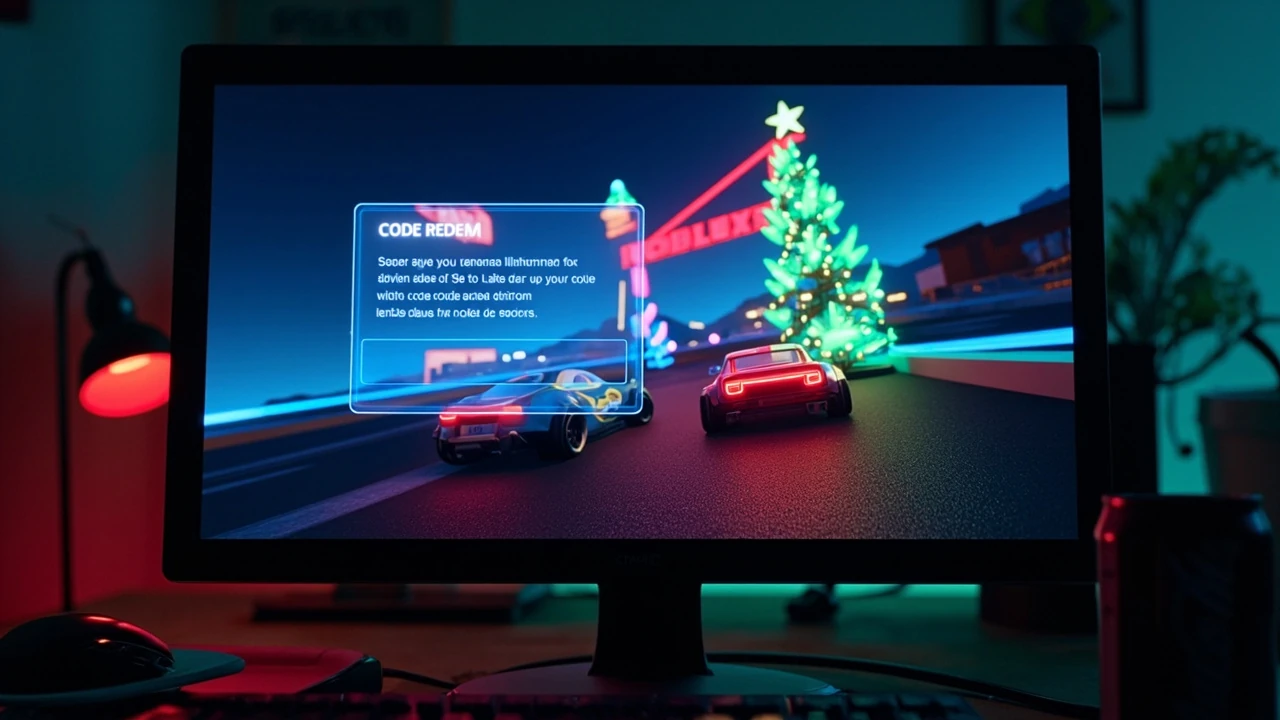
- Click the button to open a small text-entry panel. The panel typically has a single input field, a submit button, and a status line that displays “Success,” “Invalid code,” or “Already redeemed.”
- Type the code exactly as it appears in the official source. Pay attention to capitalization, hyphens, and digits, since the lookup is exact.
- Press the submit button. The status line updates within a second. A successful redemption shows a short summary of the reward and the button label changes to “Claim” so the items are added to your inventory.
- Restart the game if the reward does not appear immediately. A small number of titles apply the payload only after a clean reload because of how their inventory service is wired.
- Check the in-game mail or notification tray. A few studios send the reward through a mail system rather than dropping it straight into the inventory, and the mail often expires after 7 or 14 days if left unclaimed.
That last step catches more missed rewards than any other. The Roblox inventory service in many drag-racing games is built around periodic snapshots rather than real-time updates, so a quick restart forces a fresh sync. The mail check is a close second, because the visual difference between “in your inventory” and “waiting in mail” is not always obvious at a glance.
Common reasons a valid-looking code fails to redeem
Even when a code is real, the redemption can still fail for reasons that have nothing to do with the code itself. The table below lists the most frequent causes observed across Roblox drag-racing games in 2026, along with the diagnostic signal each one produces.
| Symptom in the status line | Most likely cause | What to check first |
|---|---|---|
| “Invalid code” on a freshly pasted string | Hidden whitespace or autocorrect changed the casing | Retype the code manually from the official source, do not paste it |
| “Code not found” on a string shown in a recent post | The post was a teaser and the code was not yet active | Check the timestamp and the comments for a follow-up that mentions activation |
| “Already redeemed” on a code you do not remember using | The account redeemed the code on a different device, or a friend used it on a shared account | Check the inventory for the reward; if it is already there, the code was consumed previously |
| “This code has expired” on a string shared today | The aggregator recycled an older code or the developer enabled an early expiration | Confirm the string against the most recent developer post within the last 24 hours |
| The status line never updates after submit | A network blip interrupted the RemoteFunction call | Rejoin the game server and try again; the request is not sent again automatically |
| “Region locked” or “Not available in your area” | The code was tied to a marketing region or a soft-launch shard | Check the developer’s announcement for regional restrictions before retrying |
| “You must be level X to redeem” | The code is gated behind an account progression threshold | Race a few more times to clear the gate, then return to the redeem panel |
Most failed redemptions fall into one of those buckets. The diagnostic step that catches the largest number of cases is a manual retype, because hidden characters from copy-paste are by far the most common silent failure. The level-gate case is the one that surprises new players the most, since the status line does not always name the threshold and the failure looks identical to a typo.
Why drag-racing games use codes at all
Codes are a live-operations tool, not a generosity gesture. They give the development team a way to push rewards to players without shipping a content patch, and they let marketing channels participate in retention by handing out drops that look exclusive. A code that grants 25,000 cash in a game where a tuned build costs several million looks generous, but it is calibrated to be small enough that it does not break the progression loop.
The pattern is well established across Roblox racing games. A launch code drives installs by giving early players a small head start, a weekly code keeps the Discord active by rewarding members who check in, and an event code funnels players into a limited-time mode. Each code has a measurable job, and the reward table is tuned so that the job is done without distorting the simulation.
For developers, the benefit is a low-effort retention channel that is easy to A/B test. For players, the benefit is a small but real reduction in grind. The system works because both sides treat it as a controlled channel rather than a free-for-all.
There is also a soft retention argument that does not show up in the reward numbers. A code gives the studio a reason to post on social media on a slow news day, and the post keeps the account visible in the player’s feed. The reward itself is often worth less than the cost of running a paid ad for the same impression, and the engagement metrics on a code post are usually higher because the audience has a clear action to take.
The case study of Drag x Drive: how a similar system looks in a paid release
Although Drag x Drive is a Nintendo Switch 2 title and not a Roblox drag-racing experience, the way its developers handled the reveal and reward flow is a useful reference for any studio shipping a driving game with a live-operations layer. The For additional context, Drag x Drive entry on Wikipedia describes the project’s design context, and the original Drag x Drive announcement coverage explains how the team positioned the title for a controlled launch window. Both pages are useful as a sanity check on how a code or reward channel is framed in a high-visibility release, and they illustrate the kind of language a legitimate code announcement uses compared with a recycled aggregator post.
Worth noting is that Drag x Drive is a paid, single-platform title with a different reward structure than a free-to-play Roblox drag racer. The comparison is useful as a reference for tone and presentation rather than as a direct functional parallel, and the verified sources are linked here for that reason rather than as evidence that the same code system applies to Roblox drag-racing games.
How reward tables are usually structured in drag-racing games
Reward tables follow a small number of standard shapes, and recognizing them makes it easier to judge whether a code is worth redeeming promptly or whether it is safe to leave for later. The table below summarizes the patterns most commonly seen in drag-racing games on Roblox in 2026.
| Reward type | Typical use | Player value | Redemption urgency |
|---|---|---|---|
| Small cash grant (5,000 to 50,000) | Daily login nudges and weekly drops | Marginal; trims a few races off the early grind | Low; safe to redeem within a week |
| Boost or refuel token pack | Event entry tokens and progression accelerators | High during limited events, low outside them | High during events, low otherwise |
| Livery, wheel, or cosmetic piece | Creator collaborations and seasonal themes | Subjective; matters most to players who customize heavily | Medium; most cosmetic codes stay active longer than currency codes |
| One-time crate with a random part | Launch hype and milestone celebrations | Variable; depends on the crate’s drop table | High when the crate is new and may be retired |
| XP multiplier (1.5x for 30 minutes, for example) | Weekend play incentives and patch-day rewards | Medium; useful when paired with a planned session | High; time-bounded multipliers lose value quickly |
| Event ticket or limited-mode unlock | Funneling players into a rotating game mode | High only while the event is live | High during the event window, zero afterward |
Reading a code announcement through that lens turns a wall of text into a quick decision. A cosmetic code can wait; an XP multiplier is worth using within the day. An event ticket is the most time-sensitive of the bunch because its value drops to nothing the moment the event closes, and a code that grants one is best redeemed before the next play session rather than the day after.
Safety: avoiding scams and account risks
Code channels attract a predictable set of scams. The most common pattern is a “generator” page that asks the player to complete a survey, install an app, or share a Roblox username and password in exchange for a code that does not exist. The second most common pattern is a look-alike Discord server that imitates the official branding and posts a fake code to harvest accounts.
The defenses are simple and the same as in any other live-operations context. Legitimate codes never require information outside the game client. They never ask for a password, a phone number, or a payment method. They never come with a download prompt, and they never require the player to log into a third-party site to “unlock” the reward. A page that does any of those things is a scam, even if it looks polished.
Beyond scams, there is a smaller risk of accidental bans. Some studios restrict redemption to one entry per account per code, and rapid-fire automated attempts can trip anti-abuse filters even when the player is just being enthusiastic. Redeeming codes at a normal pace, from inside the official client, and only on the developer’s verified channels, is enough to stay clear of that risk.
It is also worth keeping an eye on browser extensions and overlay tools. Some “Roblox helper” extensions promise auto-redeem or code alerts, and a small fraction of them read the page content on the official Roblox site. The safer path is to keep the extension list short, to review permissions whenever a new tool is installed, and to treat any extension that asks for broad site access as a red flag regardless of its stated purpose.
Reading code announcements like an editor
A useful habit when scanning a developer’s post is to read it the way an editor would read a press release. Look for a date, a code string, a list of rewards, and an expiration note. If any of those four elements is missing, the post is incomplete and the code should be treated as a teaser rather than a confirmed drop.
Date and timezone matter because Roblox servers operate on UTC and a post that says “available this weekend” can mean very different windows depending on the reader. The code string itself should be checked for spaces, hyphens, and capitalization. The reward list is where most misreporting happens, since tier-list pages often round numbers up for impact. The expiration note, when present, usually includes a specific UTC time, and that is the moment the code is expected to be retired from the live table.
Reading with that structure turns a noisy announcement into a small checklist and short-circuits most of the misinformation that circulates around drag-racing codes. It also makes it easier to spot a recycled post, because the giveaway is usually the missing date or the missing expiration note rather than a subtle change in the wording.
A secondary habit that helps is to follow the developer on at least two channels. Cross-posting is common, and seeing the same string on both Twitter and Discord in the same window is a strong signal that the drop is real. If a string only appears on one channel, especially a small one, it is worth waiting for confirmation before typing it into the redeem panel.
What to do when a code is missing from the in-game panel
If a code is genuinely active on the developer’s official channel but does not appear in the in-game panel, the cause is almost always one of three things. The first is a client cache that has not refreshed; the second is a server-side rollout that is still propagating to all shards; the third is a regional split that has not yet been enabled in the player’s data center.
The fastest fix is to fully close the Roblox client, reopen it, and rejoin the game. That forces a fresh configuration pull and resolves the cache case in most situations. If the code is still missing, waiting an hour and trying again usually catches the propagation case, since the configuration push is batched rather than instantaneous. The regional case is rarer and is usually flagged in the developer’s Discord as a known rollout issue.
It is worth keeping a short log of the codes you have redeemed and the dates, because that log makes it much easier to argue a case with the support team if a reward is genuinely missing. A screenshot of the redemption status line is usually enough for the support team to investigate.
For studios that use a remote configuration rather than a baked-in DataStore, the missing-code window can stretch from a few minutes to a few hours depending on the size of the rollout. A patient player almost always wins here, and a player who hammers the redeem button every thirty seconds is the one most likely to trip the anti-abuse filter and lock the panel for the rest of the day.
How code channels interact with patches and live events
Codes do not exist in isolation. They are tied to a patch cycle, to a live-event calendar, and to a marketing roadmap, and a player who understands the rhythm of those three will catch more drops with less effort than a player who only watches the game itself.
The patch cycle matters because some studios retire the entire code table when a new build ships. The calendar matters because event codes are usually released at the start of a mode and expire when the mode ends. The roadmap matters because a milestone code tied to a follower or download count is only active for as long as the milestone is being celebrated. Watching the official channels with those three cycles in mind turns a stream of posts into a small calendar of expected drops.
There is also a quiet fourth cycle, which is the studio’s content creator pipeline. Sponsored videos and creator-exclusive codes tend to drop in waves, often just before a weekend, and a player who has bookmarked a handful of trusted creators will catch the wave without needing to scan a tier-list page.
Where drag drive simulator codes fit in the wider GameDev topic cluster
Drag-racing codes are a small but useful entry point into a much wider set of GameDev topics. They touch on live operations, on data modeling for time-limited content, on anti-abuse design, on telemetry for redemption rates, and on player communication patterns. A studio that handles its code channel well is usually applying the same discipline to its event calendar, its patch notes, and its community moderation.
For a broader view of how redemption systems and reward tables are designed across racing games, the cluster pages linked below cover adjacent experiences and the editorial patterns that recur across them. Reading those pages alongside this one gives a fuller picture of the production decisions behind a typical Roblox drag-racing title.
There is also a useful parallel in how the wider Roblox ecosystem handles creator economy codes. Many UGC titles use a near-identical redemption pipeline, and the patterns described here translate with only minor adjustments. The same five-point verification habit, the same diagnostic table, and the same reading-as-editor approach all apply, which is why a single well-grounded article can carry a reader across most of the racing genre rather than just one title.
Frequently asked questions
How often are drag drive simulator codes released?
Most Roblox drag-racing studios release codes on a weekly cadence, with extra drops during launches, milestones, and seasonal events. The cadence is not fixed, so a player who checks the developer’s official channels once a day will catch nearly every active code without needing a third-party aggregator.
Do drag drive simulator codes expire?
Yes, almost every code has an expiration date baked into the server-side table. The expiration is usually set when the code is enabled and is sometimes tied to a specific event window. A code that worked yesterday may return an “expired” error today if the developer has retired it.
Can I use a code more than once on the same account?
No. The redemption pipeline marks a code as consumed the first time an account successfully claims it, and subsequent attempts on the same account return an “already redeemed” error. The same code can be used on a different account because the consumption is tracked per player, not per code string.
Are code lists on third-party sites trustworthy?
Some are, many are not. The reliable ones are updated within hours of a developer post and clearly cite the source. The unreliable ones recycle expired codes, inflate reward numbers, and often link to survey scams. A quick cross-check against the developer’s official post is the fastest way to sort them.
Will redeeming a code get my account banned?
No, redeeming a legitimate code through the official in-game panel will not trigger any anti-abuse system. Automated tools that hammer the redemption endpoint, or third-party “generators” that harvest credentials, are the actions that can lead to action against an account.
What should I do if a code returns “invalid” but it is listed on the developer’s page?
The most common cause is a hidden character introduced by copy-paste. Retype the code manually, paying close attention to capitalization, hyphens, and digits. If it still fails, confirm the post is from the developer’s verified account and that the post is from the current patch, not a recycled older announcement.
Can codes unlock cars or tuning parts?
Sometimes, but it depends on the studio’s reward table. A small number of drag-racing games use codes to grant a low-tier part or a starter crate. Most use codes for cash, boosts, and cosmetics, and reserve car and tuning unlocks for the core progression loop. Reading the developer’s announcement carefully will tell you which category a specific code falls into.
Why do some codes grant different rewards on different accounts?
They usually do not. If two players on the same patch see different rewards for the same code, the cause is almost always a server-side rollout that has not yet finished propagating, or a regional split that is still in progress. Waiting an hour and redeeming again is usually enough to settle the discrepancy.
Do I need to be in a specific game server to redeem a code?
No, the redemption service is global within a game. The result is applied to your account regardless of which regional server you are connected to, although the application can take a short while to propagate. A quick restart helps if the inventory does not refresh immediately.
How can I tell whether a code announcement is real or a scam?
Real announcements come from the developer’s verified account, link only to the official Roblox game page, and never ask for a password or a payment method. Scam posts often use a near-duplicate account name, promise rewards that are clearly above the developer’s usual calibration, and redirect to a survey or download page. A short verification pass through the steps above will filter out the scam in nearly every case.





Leave a Reply